
Key Takeaways
- ✓A traditional answering service puts a trained person on your phones who takes a message and relays it. An AI receptionist is software that answers, books the caller into your real schedule and follows up on its own.
- ✓The biggest practical difference is completion. A message restarts the work at your front desk the next morning. A booking made on the call is finished, with a confirmation sent.
- ✓Human operators are genuinely better with distressed, confused or unusual callers. Software is genuinely better at consistency, simultaneous calls and routine work at any hour.
- ✓Costs compare by shape, not headline. Answering services meter operator time, so busy months cost more, while AI receptionists are scoped per clinic with the setup counted up front.
- ✓Many clinics end up hybrid: software for after-hours, overflow and routine bookings, people for the conversations that need judgement, and a clean handover between the two.
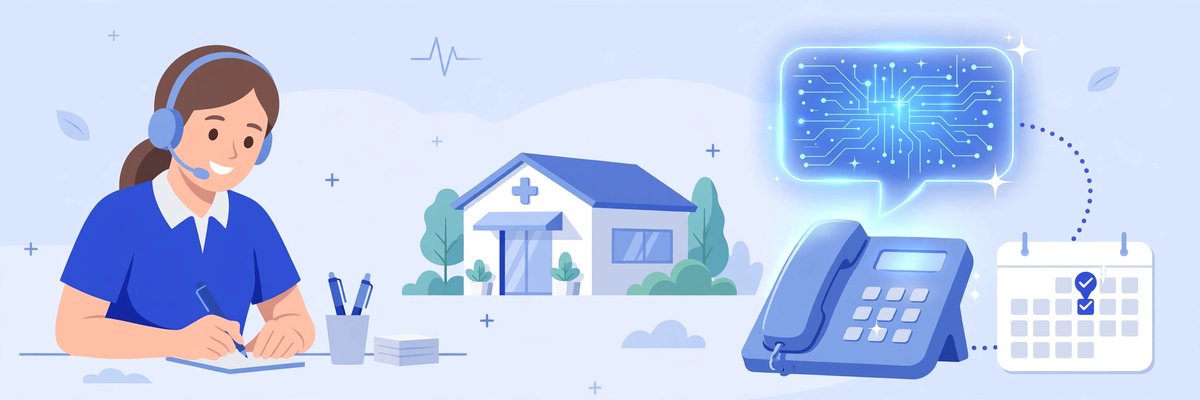
The difference between an AI receptionist and a traditional answering service is what happens during the call. A traditional answering service puts a trained human being on your phones. That person answers in your clinic's name, takes a message, and passes it to your team. An AI receptionist is software. It answers the call, works out what the caller needs, and, in the case of the system we build, books the caller into your real schedule before the conversation ends. One model relays. The other completes the front-desk task. Both can be the right choice, depending on what your calls actually need.
The choice usually lands on your desk at a recognisable moment. The lunch rush leaves two lines ringing while your team checks patients in. A patient calls at nine in the evening and reaches a voicemail box. Your best receptionist goes on leave and the cover turns out to be a hope rather than a plan. The question becomes what kind of help fits the calls you are losing. We have written separately about why clinics miss patient calls.
What a Traditional Answering Service Actually Is
A traditional answering service is a call centre that answers other businesses' phones. Its operators sit outside your clinic, often working across many accounts in the same shift. When your number rings through, your clinic's name and instructions appear on the operator's screen, and they answer as if sitting at your front desk.
The core of the service is the message. The operator follows the instructions and script you agreed when you set the account up: greet the caller in your name, ask your specified questions, write down the details, and relay the message to your team by email, text or an app, with a phone call instead for anything marked urgent. Some services sell higher tiers that add tasks, such as booking into a shared calendar. At the end of the standard call, the caller's need has been recorded. Acting on it is still your team's job, usually the next working day.
Billing follows the labour. Plans are commonly priced as a monthly base plus usage, charged per minute or per call, because what you are buying is operator time. The bill rises in your busiest months, when the phones ring most. What you are paying for is a person: someone who can listen, judge tone, and handle a conversation that does not follow the script. That is a real strength.
What an AI Receptionist Actually Is
An AI receptionist is software that answers your clinic's calls and website chats in your practice's name, at any hour you set. It holds a spoken conversation, works out what the caller needs, and acts on it against your live schedule and your booking rules. A system that answers and records a message is an answering service with a computer voice. A receptionist, human or AI, finishes the job: the booking made, the question answered, the follow-up arranged. Judge every product in this space, including ours, on which side of that line it sits. Our longer guide walks through how an AI medical receptionist works in full.
Our own system, CareDesk, is built to sit on the finishing side of the line. It answers from a knowledge base loaded with your own material, your services, prices, insurance lists and policies, rather than from general scripts. It qualifies the caller before booking, asking the reason for the visit, their insurance and the urgency, then writes the appointment into the same schedule your team uses, respecting each provider's appointment lengths and buffers. If a call is missed anyway, it texts the caller back and continues by message. Reminders, recalls and follow-ups go out on their own. And it has firm boundaries: it does not diagnose or advise on symptoms, and anything clinical, or any caller who asks for a person, goes to your team with the full transcript and a summary attached.
The Two Models Side by Side
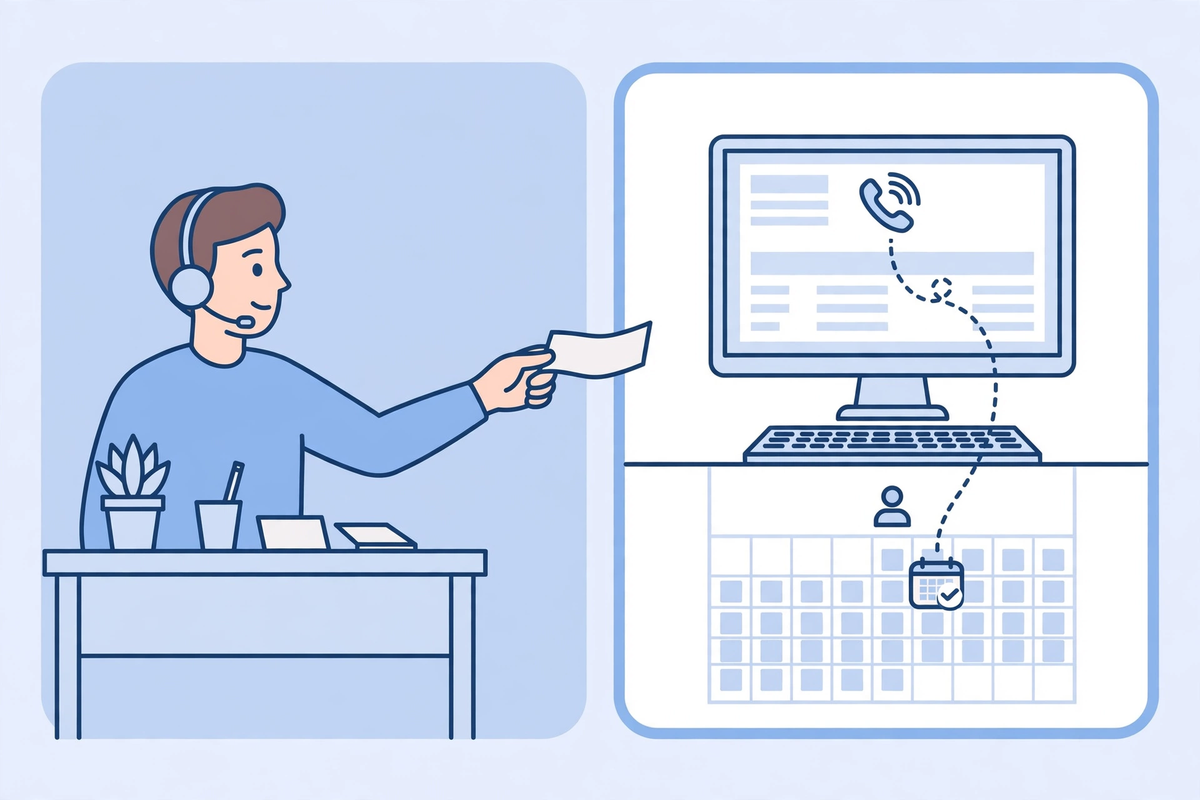
The table below puts the two models side by side on the points clinic owners raise most. Read both columns fairly. Each model has a row it would rather you skipped.
| Question | Traditional answering service | AI receptionist |
|---|---|---|
| Who answers | A trained operator at a call centre | Software, answering in your clinic's name |
| Hours of coverage | Set by your plan, often around the clock | Around the clock, as configured |
| What the caller leaves with | A promise that the clinic will call back | An answer, and usually a booked appointment |
| Booking | Relayed as a message; some plans add shared-calendar booking | Booked into your real schedule, under your booking rules |
| Several calls at once | One call per operator, so queues form at peak times | Parallel calls handled together, with no engaged tone |
| Consistency of answers | Depends on the operator and the shift | The same rules and answers on every call |
| Cost shape | Monthly base plus per-minute or per-call use, so busy months cost more | Scoped per clinic: setup plus ongoing service by scope and volume |
| Getting started | Account setup, your instructions and a script | Your policies and rules loaded, then tested with your team |
| Record of the conversation | A message slip or relay note | A full transcript, a summary and the booking, in one place |
| A distressed or unusual caller | A person who can listen and adapt | Recognises the moment and hands over to a person, with the conversation attached |
The Biggest Difference: A Message Is Not a Booking
Most clinics comparing these two models are really comparing what lands on their desk the next morning. With an answering service, it is a list of messages. Each one restarts the work: call the patient back, hope they answer, re-ask what they need, then find a slot that still exists. Some of those callers get booked. Some have already booked elsewhere, and some never pick up, so the message sits in a pile everyone means to clear.
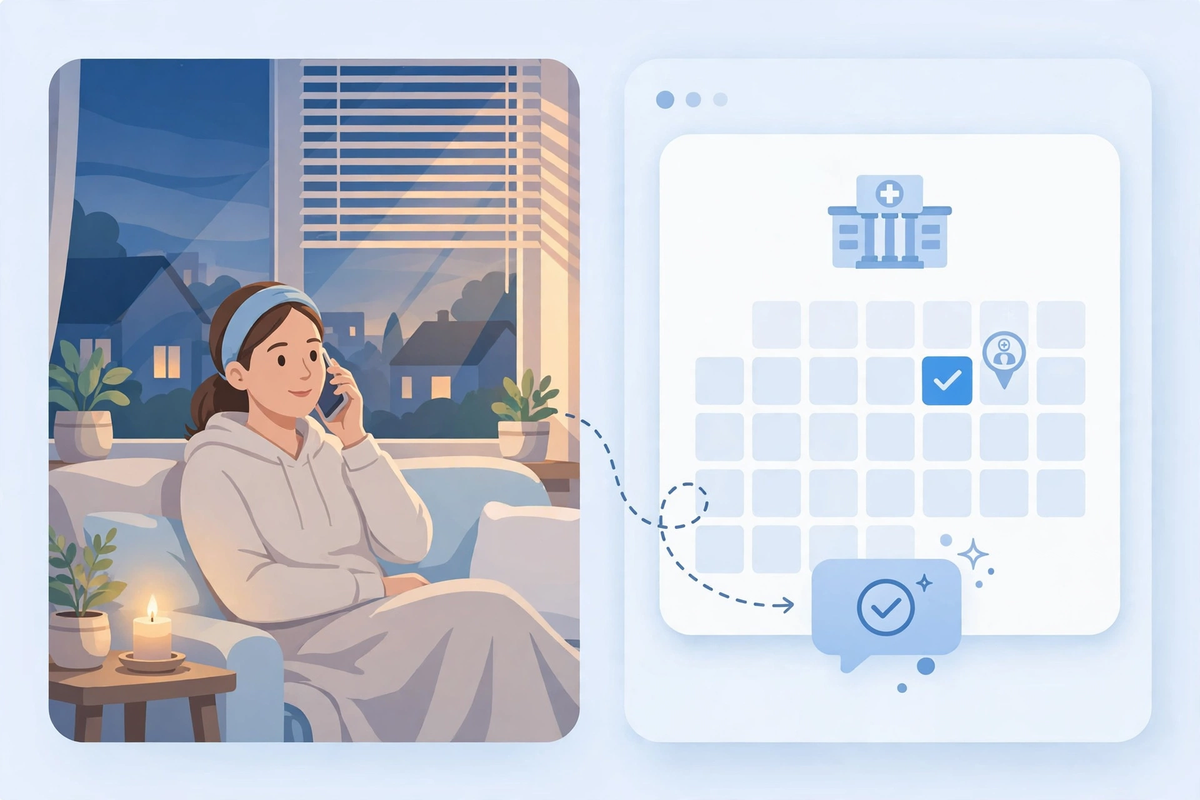
With an AI receptionist that books, the need is finished on the original call. The caller who rang at nine in the evening about a toothache wakes up with an appointment and a confirmation, and your front desk starts the day with completed bookings and the few conversations that genuinely need a person. If your unanswered calls mostly need a person's judgement, a list of well-taken messages may be exactly right. If they mostly need a slot in the diary, the message is an expensive way to delay the booking.
What Each Model Costs, and How the Bill Behaves
Neither model carries a price that means anything without your call pattern, so compare shapes rather than numbers. The answering service shape is a base fee plus metered time. It is gentle in a quiet month and grows in the months when you can least afford friction, because those are the months the phones ring. There is a second cost that never appears on the invoice: staff time spent returning calls, re-asking questions the operator was not set up to ask, and matching messages against the diary.
The AI shape is a scoped build plus an ongoing service. At Med Clinic X the receptionist is quoted per clinic after discovery, because the drivers are knowable only after someone sees your situation: locations and phone lines, call and chat volume, the policies and insurance lists to load, the systems to connect, and the support you want. Setup effort is real and should be counted honestly, because your booking rules have to be gathered and tested before the first patient call, and the cost then follows the scope you agreed, not the minutes your patients spent on the phone in a bad month.
The fair comparison runs over years, and includes your team's time on both sides. Put the service fees plus your callback hours on one side, and the setup plus service fees on the other, both doing the same work for the same clinic. A cheap arrangement that hands your front desk a pile of unfinished work every morning is not cheap. It has moved the cost onto your payroll, where it is harder to see.
Where Human Operators Are Genuinely Better
A good human operator does things no software currently does well. They hear the shake in a caller's voice. They slow down for a confused elderly patient and adapt when a conversation wanders somewhere no script anticipated. A bereaved relative calling to cancel, a parent in tears about a child, a caller whose real question is whether anyone at the clinic cares: these are conversations where a person's judgement and warmth are the service, not a feature of it.
Some callers also simply distrust automation, and a clinic serves its patients worse by forcing them through a system they resent when a person was available. None of this is a small point. If your call mix is dominated by sensitive, complicated conversations, the human column deserves the heavier weight, and any honest AI vendor should tell you so. For most clinics the mix is a blend, which is where the hybrid at the end of this article comes in.
Where the AI Is Genuinely Better
The AI's case rests on availability, consistency and completion, not on charm. It answers at three in the afternoon and three in the morning with the same patience. It handles the lunch rush pile-up without an engaged tone, because parallel calls never queue. It gives the same answer about your insurance list on the fiftieth call as on the first, because it answers from your own material rather than from memory at the end of a long shift. And it finishes work an answering service leaves behind: the booking in the diary, the intake details in a structured form, the reminder and recall sent without anyone finding a quiet five minutes.
The record is different in kind, too. A message slip tells you a patient called. A transcript tells you what was said, what was promised and what was booked, which matters the first time a patient insists they were told something different. Software has to be configured, tested and watched, and a genuinely unusual call will always suit a good operator better.
The Caller Who Needs a Person
Every clinic gets the call that should never be handled by a process: a patient describing worrying symptoms, a caller in real distress, a situation entirely unsuited to a script. What each model does with that call tells you more than any feature list. With an answering service, a person is already there, and a good operator will recognise the moment and follow your escalation instructions, relaying the call urgently to your on-call clinician. Their limit is that they are not your staff: they cannot act clinically, only pass the call on well.
With an AI receptionist, the design question is whether it knows when to stop. The standard to hold any system to is simple: it recognises urgency or distress, directs emergency symptoms to emergency services, and hands the caller to a person fast, with the conversation attached so nobody repeats themselves to a stranger. CareDesk is built to that pattern: anything clinical goes to your team with the transcript and a summary, and a caller who simply asks for a human gets one.
Patient Information and HIPAA Duties
Both models hear the same sensitive material: names, contact details, insurance information and the general reason for a visit. That makes the organisation behind the phones part of your compliance picture either way. Under HIPAA, a company that handles protected health information on your behalf is a business associate, and a written business associate agreement has to be in place before it takes patient calls. The US Department of Health and Human Services publishes guidance and sample agreement provisions for what such an agreement covers. No signed agreement, no patient calls.
The practical questions differ by model. With an answering service, ask how operators are trained on patient privacy, where messages are stored, and how they travel to you, because a message with patient details sent over an unprotected channel is a weak point worth finding early. With AI software, ask where recordings and transcripts live, who can access them, how long they are kept, and whether your conversations train shared models. Med Clinic X states on its own pages that it signs a business associate agreement with every clinic it works with and keeps each clinic's data separate. Neither model makes a clinic compliant by itself. Your own risk assessment and your staff's habits still carry that duty.
The Hybrid Many Clinics End Up With
For many clinics the honest answer is both, divided by the kind of call. Software takes the after-hours calls, the overflow at peak times and the routine bookings. People take the conversations that need judgement, whether that is your own front desk in opening hours or an answering service outside them. Some clinics run both for a season, keeping the answering service while the AI proves itself on overflow.
The join between the two is what makes or breaks the arrangement. A caller should never have to start again because the first answerer was software and the second is a person. That is why the handoff matters more than the automation: with CareDesk, the person who takes over sees the transcript and a summary, so the patient tells their story once. The wider picture sits in our plain guide to AI in healthcare, and clinics automating message triage and intake alongside the phones can scope that work under our AI healthcare solutions service.
A Short Decision Checklist
Work through these before you talk to any vendor, including us. Your answers will usually point at one model, or at the hybrid.
- Ask your phone provider for two weeks of call data: calls arrived outside opening hours, abandoned in hours, gone to voicemail. Decide from your own numbers, not a sales conversation.
- Look at what those callers mostly need: a slot in the diary and a factual answer, or reassurance and judgement. The first points to completion, the second to a person.
- If a service says it books, ask whether the booking lands in your real schedule or in a list your staff reconcile by hand. The second is message taking with better marketing.
- Price your busiest month, not your quietest, and add your team's callback time to the answering service side.
- Ask what happens with a distressed caller, emergency symptoms and a request your clinic has no policy for, and test all three before go-live.
- Confirm the business associate agreement is signed before the first patient call, and get storage, access and retention answers in writing.
The Bottom Line
A traditional answering service gives you a person who listens well and relays faithfully, and leaves the doing to your team. An AI receptionist gives you a system that answers, books and follows up on its own, and needs a person standing behind it for the calls that carry real weight. Clinics whose phones carry mostly sensitive conversations, at modest volume, may be better served by people. Clinics losing routine bookings to voicemail and morning message piles are usually better served by a system that finishes the task. Many will run both. If you want to see the AI side working before you judge it, try the live demo and put it through your awkward questions. If you would rather talk through your own call pattern, request a quote and describe the calls you are losing. The right answer depends on your clinic's calls, and any supplier who skips that question is selling, not advising.

Written by Chloe Vance
Healthcare Marketing DirectorChloe Vance has led search engine optimization and digital patient acquisition strategies for top pediatric, dental, and multi-specialty clinical chains.
Frequently Asked Questions
Common conversational queries evaluated by our natural language models concerning deployment guidelines.