

Key Takeaways
- ✓A telehealth visit legally happens where the patient sits, so your clinician needs a licence, a compact privilege, a registration, or another lawful route in that state.
- ✓The fastest lawful routes are the licensure compacts: the IMLC for physicians, the NLC for nurses, and PSYPACT for psychologists, plus telehealth registrations in about a dozen states.
- ✓A compact is not a national licence. Each state still issues, renews and regulates its own licence, with its own fees and dates.
- ✓Confirm and record the patient's physical location at every visit, and check consent, insurance and prescribing rules for that state before you start.
- ✓Federal controlled-substance flexibilities run through December 31, 2026. Plan for the in-person rule to return unless a permanent rule replaces them.
A telehealth visit legally takes place where your patient is sitting, not where your clinician is sitting. That single fact decides whether your clinic can offer video visits to patients in another state. If your clinician holds no licence or other lawful route in the patient's state, the visit should not happen, however good the video connection is.
This guide explains the rule, the routes that satisfy it, the compacts that make multi-state practice faster, the prescribing clock you need to watch, and a short checklist to run before you switch on out-of-state visits. Examples are illustrative. This is general practice information, not legal advice for a specific clinic, and state rules change often, so confirm the current position with the licensing board in each state where your patients sit.
The One Rule That Decides Everything
Every state regulates the practice of medicine inside its own borders. A telehealth visit counts as care delivered where the patient is at the time of the visit, so the clinician needs authority in that state. The US Department of Health and Human Services puts it plainly in its licensing guidance: providers must meet the licensure requirements of the state where they are located and be licensed or legally permitted to practice in the state where the patient is located.
Take a simple example. A physician licensed only in Illinois cannot treat a patient sitting in Arizona over video, even if the visit is clinically identical to one with an Illinois patient. The patient's physical location at the moment of the visit decides which state's rules apply. The same logic covers a patient who has moved, a student away at college, and a retiree spending the winter in another state.
The rule also reaches beyond physicians. Nurses, physician assistants, psychologists, therapists and other clinicians each need their own authority in the patient's state. A physician's compact licence does not cover the nurse practitioner or physician assistant on the same visit. Each clinician on the call needs their own route, which is why multi-state planning starts with a list of people, not only a list of states.
Malpractice cover follows the same logic. Before you book a visit in a new state, check that your professional liability insurance covers care delivered there. A policy written for one state may not answer for a claim that arises in another, and some carriers ask to be told when a clinician starts seeing patients in a new state.
Your Four Routes to Practising in Another State
There are four lawful routes, and most clinics use a mix of them. The right mix depends on how many patients you expect in each state and how quickly you need to start.
| Route | What it is | Who it suits | What to watch |
|---|---|---|---|
| Full licence | Apply to that state's board and meet its requirements | States where you see many patients, or states outside every compact | Slowest route, with its own fees, exams, background checks and renewal dates |
| Licensure compact | A faster route to licences in member states | Clinicians who qualify and need several states at once | Each state still issues its own licence, and not every profession has a compact |
| Telehealth registration | Register with the board to provide telehealth only | States where you see a few patients and a full licence is more than you need | No office and no in-person care in that state, with annual renewal and a fee |
| Temporary practice or reciprocity | A limited exception for existing patients who travel | A patient on holiday, at college, or spending a season away | Narrow and time-limited, and the conditions differ by state, so check the board first |
Start with patient volume. A full licence is worth the effort where you already have, or expect, a steady flow of patients. A registration or a compact route fits the states where you see a handful of patients a year. Temporary practice rules fit the patient who is away for a few weeks, not the patient who has moved.
Whatever route you choose, keep a record for each clinician and each state: the route, the issue date, the renewal date, and the fee. Renewal dates drift apart quickly once a clinician holds licences in five or six states, and a lapsed licence is the most common way a compliant clinic slips.
The Licensure Compacts, One by One
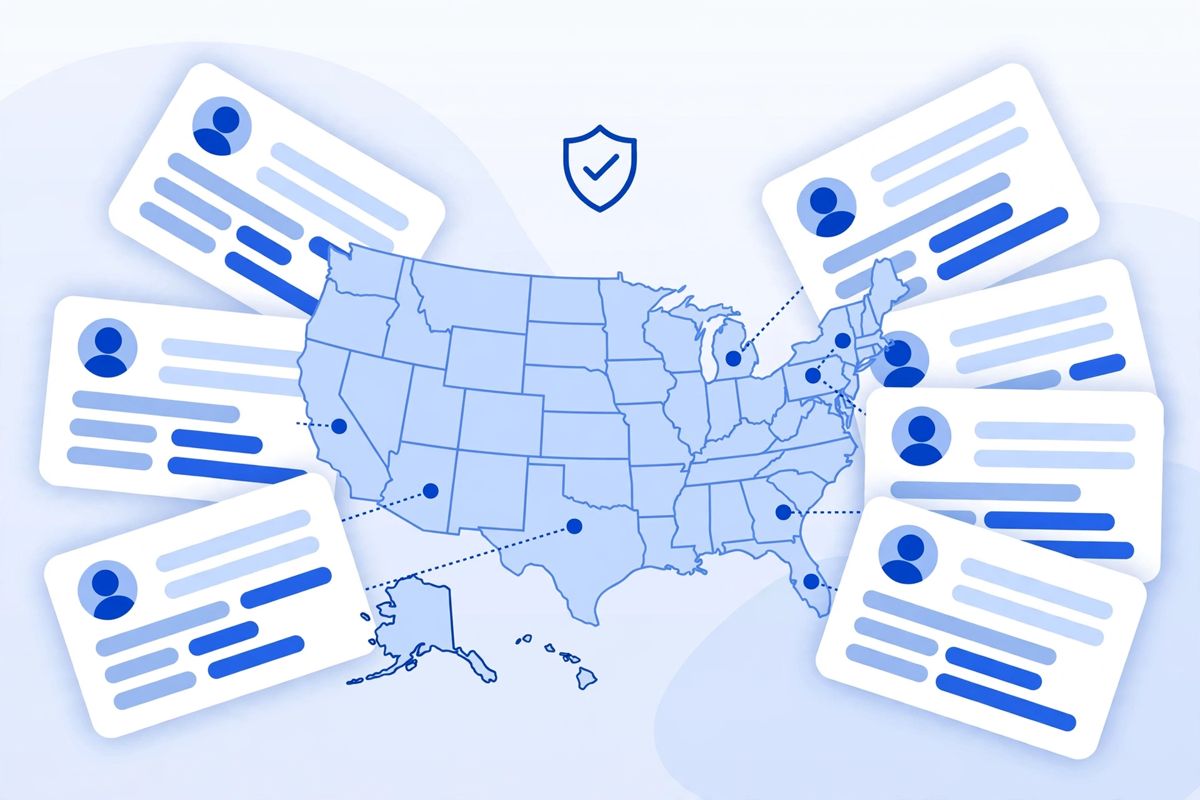
A licensure compact is an agreement between states that speeds up licensing without removing state oversight. The clinician applies once through the compact and receives expedited licences in member states, but each state still issues, renews and regulates its own licence. HHS describes compacts as a faster pathway to interstate practice, with participation voluntary for providers. Read the HHS page on licensure compacts for the full list.
Physicians use the Interstate Medical Licensure Compact, known as the IMLC. As of late 2026 it counts 44 member states plus Washington, D.C. and Guam, with Alaska the most recent state to join. A physician names one state as the state of principal licence, where they hold an active, unrestricted licence, and applies through the compact for expedited licences elsewhere. Eligibility asks for an unrestricted licence, no history of disciplinary action, and board certification or equivalent criteria. The compact charges a fee, and each state charges its own.
Nurses use the Nurse Licensure Compact, which works differently. A nurse with a multistate licence from a compact home state may practice in other compact states under that one licence. As of late 2026, 41 states take part. Psychologists use PSYPACT, which covers more than 40 states and asks for an annual authorisation to stay active. Physical therapists, occupational therapists, audiologists, speech-language pathologists and counsellors each have their own compacts too, at different stages of growth.
Counts change as states join or leave, so treat any number in this guide as a snapshot. Before you plan around a compact, open its current map and check that the state you need is a member, that your clinician meets the eligibility rules, and that the compact covers the kind of care you plan to deliver.
A compact also does not fix the rest of the visit. The clinician still needs payer enrolment in the patient's state, malpractice cover there, and a platform that meets that state's consent and privacy rules. Think of the compact as the licence step only, not the whole launch.
The States That Stay Outside the Compacts
Not every state has joined a compact. As of late 2026, California, New York and Oregon are among the states outside the IMLC, so a physician who wants to see patients there applies for a full licence through that state's own medical board, on the same timeline as any other licence application. Florida takes a different approach and offers a telehealth registration to out-of-state physicians who meet its conditions.
That gap shapes strategy. Many clinics start with the compact states, where one application opens many doors, and then weigh each holdout state on its own. The question is simple: do you expect enough patients in that state to justify a full licence, with its fees, paperwork and renewal dates? If the answer is no, the honest choice is not to offer visits there yet.
Watch the edges too. A patient who lives in a compact state but is travelling in a holdout state on the day of the visit sits under the holdout state's rules. Location is decided at the time of the visit, not by the address on the patient's chart. That is why the location check in the next section matters for every visit, not only the first one.
Confirm the Patient's Location Before Every Visit

HHS advises providers to verify patient location and obtain consent before an appointment. Make that check part of the visit, not a formality. Ask the patient where they are physically sitting, record the answer in the visit note, and confirm it again if the visit is rescheduled or the patient mentions travel.
Build the check into your workflow so it survives a busy day. The scheduler asks for the state when the visit is booked. The reminder message asks the patient to tell you if they will be in a different state on the day. The clinician confirms the location at the start of the call and notes it before the clinical conversation begins. If the patient is in a state where the clinician has no authority, the visit stops there, and the team offers the next lawful option, such as rescheduling when the patient is back or routing the visit to a clinician who is licensed in that state.
Consent matters alongside location. Some states ask for telehealth consent in a particular form, written or verbal, and rules for minors differ. Record what consent was given and how. The same note should record where the clinician was sitting, since some states and some insurers ask for that too.
This is also where your telemedicine platform earns its place. If the platform cannot capture location and consent, or cannot hold a business associate agreement that covers the states you serve, it is the wrong tool for out-of-state care. Read our guide to telemedicine platform development if you are still choosing or replacing a platform, and our telehealth for behavioural health guide for the extra location and consent rules that apply to behavioural health visits.
Prescribing Across State Lines Has Its Own Clock

Prescribing adds a federal layer on top of state licensure. The Ryan Haight Act generally asks for at least one in-person medical evaluation before a practitioner prescribes a controlled substance by telemedicine. That requirement has been suspended through a series of temporary rules since the COVID-19 public health emergency, and the current version, a fourth temporary extension, keeps the flexibility in place through December 31, 2026. It covers Schedule II to V controlled substances prescribed for a legitimate medical purpose, without a prior in-person evaluation.
Treat that date as a deadline, not a promise. Unless the Drug Enforcement Administration finalises a permanent special registration rule for telemedicine, or issues a further extension, the in-person requirement returns on January 1, 2027. A clinic that prescribes controlled substances by telehealth needs a plan for that day: which patients will need an in-person visit, which can move to a non-controlled alternative, and how the schedule will absorb the change.
Non-controlled prescribing is simpler but still state-bound. The prescription must follow the rules of the patient's state as well as your own, and some states set their own limits on what may be prescribed by telehealth, or ask for a prior relationship. Check both states before you prescribe, and keep the DEA date on your compliance calendar alongside every licence renewal.
Billing and Credentialing Follow Licensure
Payers ask for licensure in the patient's state before they approve a telehealth claim. A visit that was clinically sound and technically clean can still be denied if the clinician was not licensed where the patient sat. Credentialing and enrolment follow the same order: licence first, then enrolment, then billing.
That order decides your launch sequence. Do not book and bill visits in a new state while the licence or registration is still pending. Build the enrolment step into the plan for each state, and confirm with each payer that the clinician is enrolled for telehealth in that state before the first visit. Our guide to telehealth reimbursement covers the place-of-service, modifier and denial patterns that follow from this, and the billing mistakes that cost clinics the most.
Before You Switch It On: A Short Checklist
Run this list once for each state you plan to serve, and keep the answers in one place where the front desk and the clinicians can both find them.
- List the states where your patients actually sit, and rank them by volume, so the states that matter most get the full licence first.
- Map each clinician to a route for each state: full licence, compact, telehealth registration, or do not offer visits there yet.
- Check malpractice cover for each state, and tell your carrier when a clinician starts seeing patients somewhere new.
- Check payer enrolment for each state, and confirm telehealth is covered for the services you plan to bill.
- Build location confirmation and consent into booking, reminders, and the start of every visit.
- Check prescribing rules for each state, and put the December 31, 2026 DEA date on the compliance calendar.
- Confirm the telehealth platform holds a business associate agreement, captures location and consent, and meets each state's privacy rules. HHS publishes [sample business associate agreement provisions](https://www.hhs.gov/hipaa/for-professionals/covered-entities/sample-business-associate-agreement-provisions/index.html) that show what the agreement should cover.
- Set a renewal calendar with a separate date for every licence, registration and compact privilege, with an owner for each one.
- Decide in advance what happens when a patient travels to a state you do not cover, so the front desk has an answer ready.
If any item on the list has no answer, that state waits. A short delay while a licence or registration is processed costs far less than a visit delivered without authority, a denied claim, or a board complaint.
The Bottom Line
Telehealth across state lines is not a technology problem. The video works. The question is whether your clinician holds the right authority in the state where the patient sits, and whether your billing, insurance and prescribing all follow from that authority. Get the licence map right first, and the rest of the launch follows.
Start with the states where your patients already are, pick the fastest lawful route for each one, and put the location check and the DEA date into your daily workflow. If you want help shaping the platform and the workflow behind out-of-state visits, see the demos or request a quote and talk through the states your patients sit in first.

Written by Chloe Vance
Healthcare Marketing DirectorChloe Vance has led search engine optimization and digital patient acquisition strategies for top pediatric, dental, and multi-specialty clinical chains.
Frequently Asked Questions
Common conversational queries evaluated by our natural language models concerning deployment guidelines.