
Key Takeaways
- ✓OSHA rules apply to almost every private clinic, whatever its size. Only the injury recordkeeping rule has a small-employer threshold, at more than 10 employees.
- ✓Five standards do most of the work: bloodborne pathogens, hazard communication, protective equipment, respiratory protection, and recordkeeping, behind the general duty clause.
- ✓A written Exposure Control Plan is the first document an inspector asks for. It must name exposed jobs and tasks, cover hepatitis B vaccination, and be reviewed every year.
- ✓In 2026 a serious violation can cost up to $16,550 and a willful or repeated one up to $165,514, with no inflation adjustment from the 2025 amounts.
- ✓Most clinics can get the basics in place in about 30 days, and OSHA's free On-Site Consultation Program gives confidential help without citations.
OSHA applies to almost every private clinic in the United States, and most owners only think about it when a letter arrives or an inspector walks in. The rules cover the everyday risks of clinic work: blood, sharps, disinfectants and X-ray equipment. A serious violation can cost up to $16,550, and a willful or repeated one up to $165,514, under the penalty amounts in effect for 2026. This article sets out what your practice has to do, and how to get compliant in about a month.
A note on scope first. This article explains the rules in plain language. It is not legal advice, and it does not replace your state plan or your employment lawyer. Federal OSHA covers private-sector employers. In one of the 22 states or territories with its own OSHA-approved state plan, your state agency enforces rules at least as protective as the federal ones, so check those first. The examples are illustrative.
Does OSHA Apply to Your Clinic?
If your clinic is a private practice, yes. The Occupational Safety and Health Act covers nearly every private-sector employer, whatever your size. There is no small-clinic exemption from the bloodborne pathogens standard, the hazard communication standard, or the duty to provide protective equipment. Size only changes two things: the recordkeeping rule has a threshold, covered below, and penalty amounts can be reduced for small employers. A two-physician practice has the same duties as a fifty-person group, just fewer people to train.
Public clinics are the exception. Federal OSHA does not cover state and local government workers in states without a state plan, so a county-run clinic there follows state safety rules instead. If your clinic is part of a hospital system or a university, check which entity employs your staff, because that decides whose rules apply.
The Five Standards That Matter Most
OSHA has dozens of standards, but five do most of the work in a clinic. Behind them sits the general duty clause, section 5(a)(1) of the OSH Act, which requires an employer to provide a workplace free from recognised hazards, even where no specific standard names the hazard. The table below is your map.
| Standard | Rule | What it asks of your clinic | Who it touches |
|---|---|---|---|
| Bloodborne pathogens | 29 CFR 1910.1030 | A written Exposure Control Plan, hepatitis B vaccination, sharps controls | Staff who may contact blood or body fluids |
| Hazard communication | 29 CFR 1910.1200 | A written programme, chemical list, safety data sheets, labels | Staff handling disinfectants, sterilants, lab chemicals |
| Personal protective equipment | 29 CFR 1910.132 | A hazard assessment, gloves, gowns and eye protection at no cost, training | Clinical and cleaning staff |
| Respiratory protection | 29 CFR 1910.134 | Fit testing and medical evaluation where respirators are used | Staff in isolation rooms or aerosol procedures |
| Recordkeeping | 29 CFR Part 1904 | Injury logs, an annual summary, fast severe-injury reporting | Practices with more than 10 employees |
Two more standards appear in some clinics. If you use X-ray equipment, the ionising radiation standard, 29 CFR 1910.1096, and your state radiation rules also apply. Exit routes and fire extinguishers have their own standards too, but those are building matters your landlord usually shares.
Bloodborne Pathogens: The Standard Every Clinic Meets
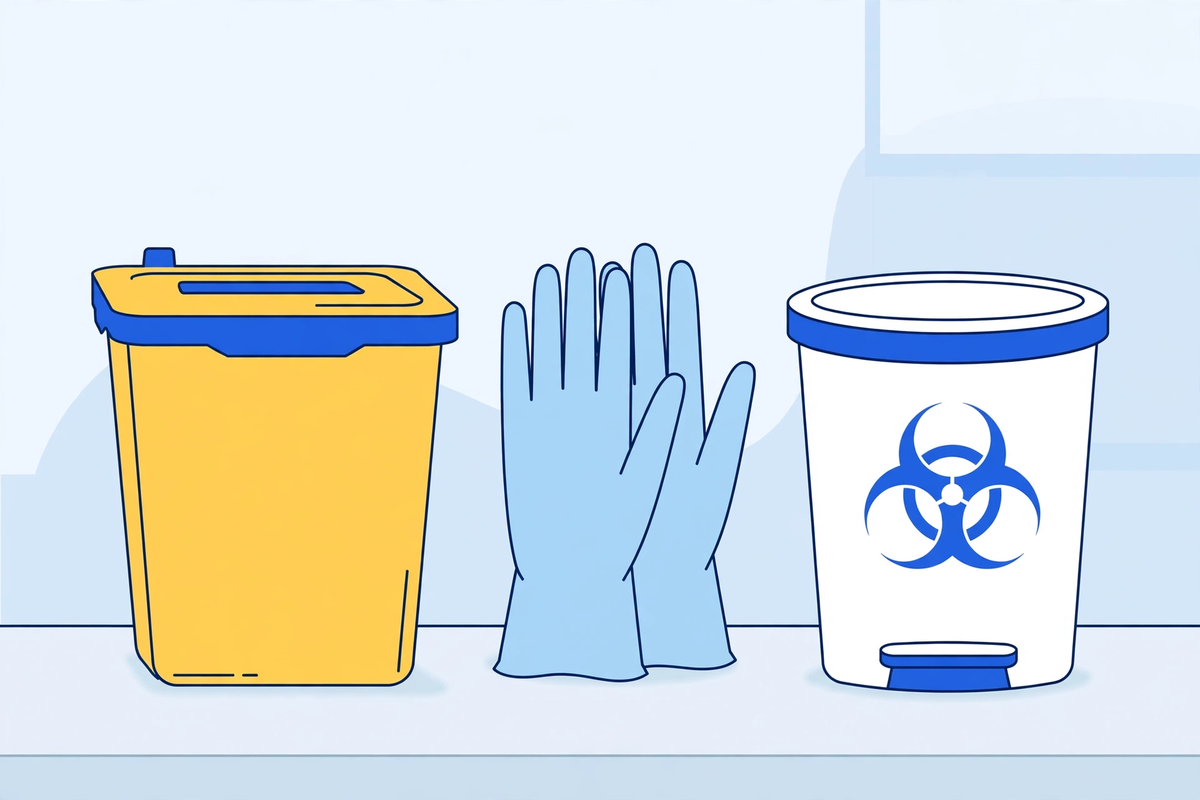
Inspectors ask about this standard first, because it touches the core of clinic work. Under 29 CFR 1910.1030, any employer with an employee who may contact blood or other potentially infectious materials must keep a written Exposure Control Plan. That covers almost every clinic: physicians, nurses, medical assistants, phlebotomists, dental hygienists, and housekeeping and laundry staff who handle contaminated linen. Coverage is decided by the tasks a person performs, not their job title.
The plan has to name the jobs and tasks with exposure, describe the controls you use, set out the hepatitis B vaccination programme and the post-exposure procedure, and cover labels and training. It must be accessible to employees, reviewed at least once a year, and updated when a task, procedure or device changes. When you choose safer sharps devices, seek input from the non-managerial staff who use them, and document that you asked.
- Offer the hepatitis B vaccine series to every exposed employee, at no cost, after training and within 10 working days of their first assignment. An employee may decline in writing, and you must offer it again later.
- Use engineering controls first: sharps containers close to where sharps are used, self-sheathing needles, needleless systems and retractable lancets where they fit.
- Never recap a needle by hand. Wash hands after removing gloves, and decontaminate surfaces after contact with blood.
- Keep a sharps injury log if your clinic keeps injury records, noting the device type, the department and how it happened, without the employee's name.
- After any exposure, provide a confidential medical evaluation and follow-up at no cost, and keep the written opinion and exposure records as the standard requires.
The full text of the standard is public. Read it at the eCFR page for 29 CFR 1910.1030 before you write your plan, and check your plan against it line by line. A generic template copied from the internet is not a plan: it has to describe your rooms, your devices and your tasks.
Hazard Communication: Know Every Chemical in the Building
A clinic holds more hazardous chemicals than most owners realise: surface disinfectants, instrument sterilants such as glutaraldehyde, formaldehyde in some labs, anaesthetic gases, mercury in older equipment, and the cleaning products in the store cupboard. The hazard communication standard, 29 CFR 1910.1200, requires you to know what you hold, label it, and train the people who handle it.
The standard has four parts. Keep a written hazard communication programme naming who is responsible, how the chemical list is kept current, how labels are handled, and how safety data sheets and training are managed. Keep a list of every hazardous chemical on site. Hold a safety data sheet for each one, in the standard 16-section format, reachable by employees during their shift without asking a supervisor for a key. Label every container, including secondary bottles staff decant chemicals into.
Training comes before the first assignment, not after the first week, and again whenever a new hazard enters the workplace. Staff need to know where the written programme and the data sheets live, how to read a label and a data sheet, and the hazards of the chemicals in their area. A short talk at induction is not enough if it never names the chemicals in your rooms.

Protective Equipment and Respirators: Provide It, Fit It, Train on It
The personal protective equipment standard, 29 CFR 1910.132, starts with a written hazard assessment. Walk each role through its tasks, note where contact with blood, splashes or airborne particles can happen, and choose the equipment that covers it: gloves, gowns, masks and eye protection. Provide it at no cost to employees, and train them on when to use it, how to put it on and take it off, its limits, and how to look after it.
Where respirators are used, for example around a patient with suspected tuberculosis, 29 CFR 1910.134 adds a medical evaluation, a fit test, and annual training. A surgical mask is not a respirator, and the two are not interchangeable. If no one in your clinic wears a respirator, the standard does not apply, but the assessment that reached that conclusion belongs in writing.
Training: Who Needs What, and When
Training is where most small clinics fall short: it is easy to postpone and hard to prove later. Two rules set the rhythm. Bloodborne pathogens training happens at hire and at least once a year after that, and again when a task or procedure changes. Hazard communication training happens before the first assignment involving a chemical, and again when a new hazard arrives. Protective equipment training happens when it is issued. Put the dates on a calendar at the start of the year, and treat them like appointment slots.
- Record the date, the trainer, the names of everyone trained, and the topics covered, and keep the records for at least three years.
- Train in the language and at the level your staff actually use. A signed attendance sheet proves someone sat in the room, not that they understood the content, so ask questions and watch the work.
- Cover temporary, part-time and agency staff too: a locum nurse who draws blood on a Tuesday needs the same briefing as a permanent hire.
- Keep staff medical and exposure records separate from patient charts, and treat them as confidential. The same care applies to your patient data, covered in our guide to website security and patient privacy.
The habit transfers. If you already run a training routine for patient-data safety, use the same discipline here: our guide to HIPAA staff training for clinics sets out the same pattern on the data side.

Recordkeeping: The 300 Log, the Annual Summary, and the 8-Hour Rule
Most clinics with more than 10 employees at any time during the previous calendar year must keep injury and illness records under 29 CFR Part 1904. Smaller clinics are exempt from routine recordkeeping, but no clinic is exempt from reporting a severe injury.
| Form or duty | What it is | Deadline |
|---|---|---|
| OSHA Form 300 | The running log, one line per recordable case | Within 7 calendar days of learning it is recordable |
| OSHA Form 301 | The detailed incident report for each case | Within 7 calendar days, alongside the log entry |
| OSHA Form 300A | The annual summary of the log, certified by a company executive | Complete by February 1, post it from February 1 to April 30 |
| Electronic submission | Larger covered establishments submit through OSHA's Injury Tracking Application | By March 2 of the following year, if your establishment is covered |
| Severe injury report | A work-related death, in-patient hospitalisation, amputation or loss of an eye | Death within 8 hours, the rest within 24 hours |
Keep the records for five years. A case goes on the log when it is work-related, new, and meets a recording criterion, such as death, days away from work, restricted work, medical treatment beyond first aid, or loss of consciousness. First aid alone does not make a case recordable. Most small clinics need not submit data electronically, so check whether your establishment is covered before you assume the March 2 date applies. The reporting rule is the one to memorise: the 8-hour and 24-hour clocks run for every employer, whatever your size. Read the full requirements on OSHA's recordkeeping page.
What Happens When OSHA Inspects Your Clinic
Inspections usually start in one of four ways: a complaint from an employee, a referral from another agency, a report of a severe injury, or a programmed inspection of a high-hazard industry. Healthcare is not among the most inspected industries, but complaints and severe injury reports reach clinics regularly. An inspector arrives, shows credentials, and holds an opening conference to explain why they are there.
The walkaround comes next, with a representative of your clinic and, if your staff have one, an employee representative. The inspector will look at sharps containers, labels, safety data sheets, protective equipment and exits, and will ask to see your Exposure Control Plan, training records, hazard communication programme and injury logs. Those four documents are the fastest way to show a clinic is organised, or that it is not.
The visit ends with a closing conference, where the inspector explains any apparent violations and the dates for correcting them. Citations, if any, arrive later in writing. You have 15 working days to contest a citation. Employees have the right to complain to OSHA, to do so anonymously, and to be free from retaliation for raising a safety concern. Never try to find out who filed a complaint.
What the Fines Cost in 2026
OSHA penalty maximums are set by statute and adjusted for inflation each January. For 2026 there was no adjustment, because the Bureau of Labor Statistics could not produce the October 2025 consumer price figure during the government shutdown, so the 2025 amounts remain in effect. The figures below are the maximums, not typical amounts. Inspectors propose penalties from the gravity of the violation, then apply reductions for size, good faith and history.
| Violation type | Minimum | Maximum |
|---|---|---|
| Serious | $1,085 per violation | $16,550 per violation |
| Other-than-serious | $0 | $16,550 per violation |
| Failure to abate | No minimum | $16,550 per day beyond the abatement date |
| Repeat | $4,256 per violation | $165,514 per violation |
| Willful | $11,823 per violation | $165,514 per violation |
A willful violation means the employer knew of the hazard and did nothing, or acted with plain indifference to the law. A repeated violation means the same or a substantially similar condition appeared again within three years of a final order. The maximums are the ceiling. Most citations settle well below them, and a small clinic with a written programme and training records is far better placed than one with nothing on paper. Check the current figures on OSHA's penalties page.
Eight Mistakes Inspectors See in Small Clinics
- No written Exposure Control Plan at all, or a template that names another clinic's rooms and devices.
- A plan written once and never reviewed, so it still lists staff who left years ago.
- Safety data sheets missing, out of date, or kept in an office no one can enter during a shift.
- New hires drawing blood or handling chemicals before their first training session.
- Sharps containers filled past the line, or placed so far from the point of use that staff carry used sharps across the room.
- Needles recapped by hand, the one habit the standard names directly.
- No sharps injury log, so a pattern of needlesticks never shows up until someone is hurt badly.
- A 300A summary completed but never posted, or injury records kept nowhere at all.
None of these is expensive to fix. Each one is cheap to prevent and costly to explain after an inspection.
Getting Compliant in 30 Days
You do not need a consultant to get the basics in place. Four weeks, one owner, and a few hours a week will cover it.
- Week 1: Name one person to own safety. Walk every room with a notebook and list every chemical, every task that may contact blood, and every place sharps are used.
- Week 2: Write the Exposure Control Plan and the hazard communication programme, or rewrite the ones you have so they describe your clinic. Gather the safety data sheets and label secondary containers.
- Week 3: Train everyone, including part-time and agency staff. Offer the hepatitis B vaccine to exposed staff. Set up the sharps injury log and the 300 log if your size requires it.
- Week 4: Do a mock walkthrough with your own checklist. Fix what you find, file the records where staff can reach them, and put the annual review and next training dates on the calendar.
If you want help without inviting enforcement, OSHA's On-Site Consultation Program offers free and confidential advice to small and medium-sized businesses. It is separate from enforcement, so it does not result in penalties or citations, and it can recommend a site for a one-year exemption from routine programmed inspections once its criteria are met. Find your local office through OSHA's consultation programme or by calling 1-800-321-OSHA.
The Bottom Line
OSHA compliance for a clinic is mostly paperwork that describes real work: a plan for blood and sharps, a list of chemicals with their data sheets, protective equipment that fits, training that happens on time, and records that are kept. None of it is glamorous. All of it is what an inspector asks for first, and what protects your staff every day. Start with the Exposure Control Plan and the chemical list. Those two documents, kept current, cover most of what can go wrong.
OSHA protects your staff. HIPAA protects your patients' data, and the two sit side by side in a well-run clinic. Our guide to HIPAA risk assessment for clinics covers the data side in the same plain style, and our HIPAA compliance consulting service can help with that half. For the software side, see a demo of what Med Clinic X builds, or get a quote.

Written by Chloe Vance
Healthcare Marketing DirectorChloe Vance has led search engine optimization and digital patient acquisition strategies for top pediatric, dental, and multi-specialty clinical chains.
Frequently Asked Questions
Common conversational queries evaluated by our natural language models concerning deployment guidelines.