

Key Takeaways
- ✓A Medicare annual wellness visit is a once-a-year, conversation-based planning visit, not a physical exam. Medicare Part B covers it once every 12 months.
- ✓The patient pays nothing for the visit itself when the practice accepts assignment. No deductible, no coinsurance, no copay.
- ✓Three codes cover the family: G0402 for the Welcome to Medicare visit, G0438 for the first wellness visit, and G0439 for every one after that.
- ✓The visit has fixed parts: a health risk assessment, history, measurements, a cognitive check, a mood and safety review, a medicine list, and a written prevention plan covering the next five to ten years.
- ✓Run it as a small system: find eligible patients, send the questionnaire ahead, use a note template, hand the patient the written plan, and book the next visit before they leave.
A Medicare annual wellness visit is a once-a-year, conversation-based visit that builds a prevention plan for a patient. It is not a physical exam, and Medicare Part B covers it once every 12 months with no deductible or coinsurance for the patient, as long as your practice accepts assignment. The visit pays, it brings older patients back on a regular rhythm, and it catches gaps in screening before they become problems. This guide explains what the visit includes, the three codes that decide how it is billed, and a workflow that keeps it from turning into a documentation headache.
The details come from Medicare.gov, the CMS Medicare Learning Network, and the American Academy of Family Physicians, linked where they appear. Nothing here is billing or legal advice, so check with your biller or counsel before you change how you code. The examples are illustrative.
What the Annual Wellness Visit Actually Is
The annual wellness visit, usually shortened to AWV, is a preventive visit for people with Medicare Part B. The patient fills in a health risk assessment, a questionnaire about their health, daily life, and habits. The clinician reviews medical and family history, takes routine measurements, checks memory and mood, looks at fall risk and home safety, and reviews the medicines the patient takes. The visit ends with a written prevention plan: the screenings, vaccines, and follow-up the patient needs over the next five to ten years.
Think of it as planning, not examining. Medicare describes it as a conversation-based visit to create a prevention plan. No hands-on physical exam is part of it, and no lab work is included. If a patient raises a new problem during the visit, that is a different piece of work, and it is billed separately. Keeping that line clear is the single most useful thing a practice can do with this visit.
The visit suits a primary care practice well. Your older patients already see you, you already hold their history, and the visit gives you a reason to bring them back once a year for a structured review. It also creates a clean record of what has been checked and what is still due, which helps when a patient moves between clinicians or when a family member asks what is being watched.
What It Is Not, and Why Patients Get Confused
Patients arrive expecting a yearly physical, and the confusion is fair. For years, a yearly check-up meant a head-to-toe exam. Medicare does not cover routine physicals. The annual wellness visit is the benefit Medicare does cover, and it is a different visit. Say that plainly when you book the appointment, or the patient will feel short-changed when no exam happens.
- A routine physical exam: hands-on, head to toe. Medicare does not cover it, and the patient pays for it in full if you do one.
- A problem visit: a visit about a new symptom, a change in a condition, or a medicine adjustment. It is billed separately, and cost sharing can apply.
- The Welcome to Medicare visit: a one-time preventive visit in the first 12 months of Part B, billed as G0402. It is not the same visit as the annual wellness visit.
- An annual wellness visit: a planning conversation, billed as G0438 the first time and G0439 after that, with no cost to the patient when you accept assignment.
Put the difference in writing before the visit. A short note in the booking confirmation and a line on the reminder call stops most of the disappointment. Patients who know what to expect rate the visit well, because the plan they leave with is genuinely useful. Patients who expected a physical and got a conversation feel misled, even when the visit itself was done properly.
Who Qualifies, and When
A patient qualifies for an annual wellness visit once they have had Medicare Part B for more than 12 months. The first visit cannot take place within 12 months of Part B enrolment, and it cannot take place within 12 months of a Welcome to Medicare visit. A patient does not need to have had a Welcome to Medicare visit to qualify.
After the first wellness visit, the patient can have another one once every 12 months. In practice, Medicare counts 11 full calendar months since the last one, so a patient seen in November can come back the following October. Check eligibility before you book, through your Medicare Administrative Contractor or the eligibility system your biller uses, because a visit booked too early is a visit that will not be paid.
Medicare Advantage plans cover the visit too, but their rules can differ from Traditional Medicare. If many of your older patients are in one, check that plan's own wellness visit rules before you build your workflow around the Traditional Medicare version.
What Happens During the Visit
The visit has a fixed set of parts. Medicare lists them, and the note has to show them. The first visit establishes the baseline, and later visits update it. The parts are the same in outline, and the depth changes.
- Health risk assessment: the patient answers questions about health status, daily activities, mood, safety at home, and habits such as smoking, drinking, activity, and diet. Send it before the visit so the appointment is a conversation, not a form.
- Medical and family history: what has changed since last time, and who else is involved in the patient's care. Keep the list of other clinicians current.
- Routine measurements: height, weight, body mass index, and blood pressure. The first visit includes height, and later visits update the rest.
- Cognitive check: a brief assessment of memory and thinking, plus any concerns raised by the patient or a family member. If it raises a flag, Medicare covers a separate, more thorough cognitive visit.
- Depression and mood: a review of risk factors for depression, using a standard tool. A short screen done properly is enough.
- Function and safety: hearing, the ability to manage daily tasks such as bathing, dressing, and handling money, fall risk, and safety at home.
- Medicines: a full list, including over-the-counter medicines and supplements, checked for interactions and for anything no longer needed.
- Prevention plan: a written screening schedule for the next five to ten years, built on US Preventive Services Task Force and Advisory Committee on Immunization Practices recommendations, plus advice on activity, food, and vaccines.
- Advance care planning: offered at the patient's choice, and billed separately if the patient wants it.
- Opioid and substance use review: current opioid prescriptions are reviewed, and risk factors for substance use disorder are checked, with a referral if needed.
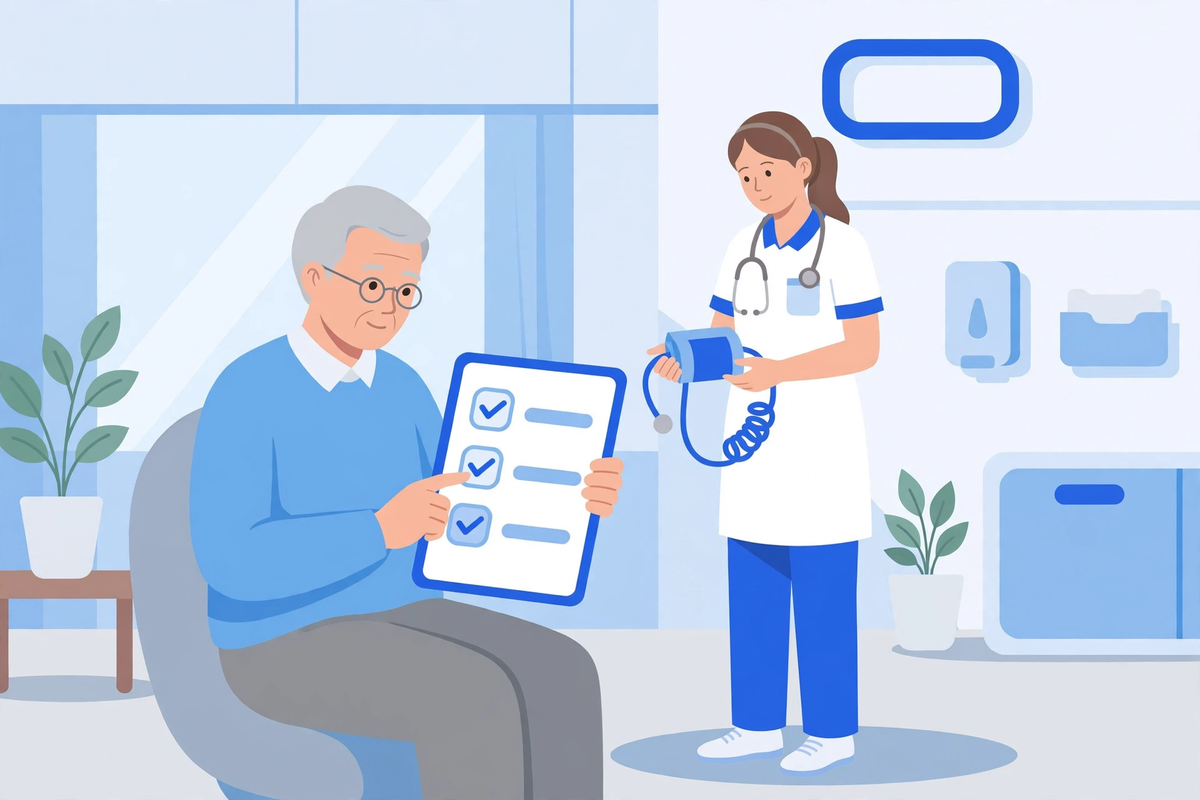
Most of the visit can be done by the team before the clinician walks in. A medical assistant can take the measurements and hand over the completed risk assessment. A nurse can run the standard screens. The clinician's time is then spent on the conversation, the plan, and the decisions. That division of work is what makes the visit pay, because the clinician's part is short.
The Codes, and How the Visit Gets Paid
Three codes cover the whole family of Medicare preventive visits. One code per visit, and the code depends on where the patient sits in their Medicare timeline, not on how long the visit took.
| Code | Visit | When it applies | How often |
|---|---|---|---|
| G0402 | Welcome to Medicare visit (Initial Preventive Physical Exam) | First 12 months of Part B | Once per lifetime |
| G0438 | Initial annual wellness visit | First wellness visit, after 12 months of Part B | Once per lifetime |
| G0439 | Subsequent annual wellness visit | Every wellness visit after the first | Once every 12 months |
G0438 pays more than G0439, because the first visit builds the health risk assessment and the prevention plan from scratch. Later visits update them, so the work is lighter. Do not quote payment amounts to patients or to each other as if they were fixed, because the amount depends on your locality and on the year's fee schedule. Look up your own locality's figure in the CMS Physician Fee Schedule look-up tool.
The patient pays nothing for the wellness visit itself when your practice accepts assignment. No deductible, no coinsurance, no copay. That is the benefit, and it is worth saying clearly when you invite patients, because cost is the first question most of them ask.
The rule changes when the visit stops being only a wellness visit. If you deal with a new problem in the same appointment, that work is billed separately, usually with an office visit code and modifier 25, and the patient may owe a copay and deductible for that part. Tell the patient before you start the problem work, not after, and document the two parts as two pieces of work. A patient who gets a bill for a visit they thought was free will not come back for the next one.
The full rules sit in the CMS Medicare Learning Network publication on Medicare wellness visits, and the American Academy of Family Physicians guide to annual wellness visits sets out the coding and documentation requirements in practice terms.

If you run a patient portal, the plan can go there after the visit, so the patient can find it without calling. Our guide to how much a patient portal costs sets out the routes and their price bands if you are still deciding how to put one in place.
Who Can Carry Out the Visit
Medicare lets a doctor or another qualified health professional carry out the annual wellness visit. In practice, that means a doctor, a nurse practitioner, or a physician assistant can run it. Many practices have a nurse practitioner or physician assistant do the visit, with the doctor available for anything that needs a physician's judgement. That is a fair use of the team, and it keeps the doctor's diary free for problem visits.
Whoever runs the visit needs time, a template, and a habit. Time, because a rushed wellness visit reads as a tick-box exercise and patients notice. A template, because the required elements are fixed and a good note template makes sure none of them is missed. A habit, because the visit only works as a yearly rhythm, and a rhythm needs someone who owns it.
Give one person ownership of the programme. A care coordinator or a lead nurse who watches the list of eligible patients, books the visits, and chases unfinished plans will do more for your numbers than any amount of reminding at the front desk.
The health risk assessment holds patient information, so the usual HIPAA protections apply, and any vendor that handles it on your behalf needs a business associate agreement. HHS publishes sample business associate agreement provisions that show what one should cover.
Running Annual Wellness Visits in Your Clinic
A wellness visit programme is a small system, and it has five moving parts. Get them right once, and the visits mostly run themselves.
- Find the patients: pull a list of your Medicare patients who have had Part B for more than 12 months and have not had a wellness visit in the past year. Start with the patients you see most often.
- Invite them: a short message explaining that the visit is free, what it covers, and what it is not. A phone call works, a portal message works, and a letter works for patients who do not use either.
- Send the health risk assessment ahead: the patient completes it at home or in the waiting room, and the answers are in the record before the visit starts. Your intake flow is the place to put it, so the questionnaire arrives with the rest of the patient's information instead of on a separate clipboard.
- Run the visit on a template: measurements and screens first, then the clinician's conversation, then the plan. A 30-minute slot is enough for most patients, and a 45-minute slot is safer for a first visit.
- Close the loop: the plan goes to the patient in writing, the screenings that are due get booked, and the next visit goes in the diary for a year on. If you do not book the follow-up, the patient will not come back on their own.
| Step | Who does it | What good looks like |
|---|---|---|
| Find eligible patients | Care coordinator | A list refreshed monthly, with no one invited twice in a year |
| Send the health risk assessment | Front desk or portal | Completed before the visit, already in the record |
| Run the visit | Nurse practitioner, physician assistant, or doctor | All required elements documented, plan written |
| Share the plan | Clinician and front desk | Patient leaves with the plan, or finds it in the portal |
| Book the follow-up | Front desk | Next visit booked, screening referrals sent |

Booking matters more than marketing. A practice that books the next visit before the patient leaves will keep its list full. A practice that tells the patient to call in a year will not. Our guide to missed calls in medical practices describes what happens when the phone is the weak point, and a wellness visit programme lives or dies on patients being able to reach you.
Can You Do a Wellness Visit by Video?
Yes, in most cases. Medicare allows annual wellness visits by telehealth, and many practices now offer the conversation by video, with measurements taken in person or at a recent visit. The risk assessment, history review, cognitive check, and planning conversation all work over video. Blood pressure and weight need a reading, so agree in advance how that will be captured.
Treat a video wellness visit like any other telehealth visit: a clear booking, a working connection, and a note that says what was done by video and what was not. The billing rules for telehealth change from year to year, so check the current position before you build a telehealth wellness clinic around it. Our guide to telehealth reimbursement for clinics sets out the place-of-service and modifier rules that apply to telehealth billing in general.
Mistakes That Cost Clinics Denials and Unhappy Patients
- Billing the first visit twice. G0438 is once per lifetime. A second G0438 for the same patient will be denied, so check the record before you code.
- Booking too early. G0439 needs 11 full calendar months since the last wellness visit. A visit booked a month early will not be paid.
- Billing a wellness visit within 12 months of a Welcome to Medicare visit. The two cannot sit that close together.
- Turning the visit into a physical without saying so. A patient who gets a bill for a physical they did not ask for will complain, and the complaint will cost more than the visit was worth.
- Skipping the written plan. The plan is the point of the visit. A visit with no written screening schedule is a visit that cannot be defended if it is ever reviewed.
- Letting the health risk assessment sit blank. The assessment is a required element, and a note without it is an incomplete note.
The Bottom Line
The annual wellness visit is one of the few things in Medicare that is simple, paid, and useful to patients at the same time. It costs the patient nothing, it gives your practice a yearly reason to see its older patients, and it produces a plan that actually gets used. Run it on a template, staff it with the team, book the next visit before the patient leaves, and keep the line clear between the wellness visit and the problem visit. If you want help shaping the systems behind it, from the intake questionnaire to the portal where the plan lives, see the demos or request a quote.

Written by Chloe Vance
Healthcare Marketing DirectorChloe Vance has led search engine optimization and digital patient acquisition strategies for top pediatric, dental, and multi-specialty clinical chains.
Frequently Asked Questions
Common conversational queries evaluated by our natural language models concerning deployment guidelines.