
Key Takeaways
- ✓Opening a medical practice usually takes six to twelve months, and most of that time goes to state licensing, payer credentialing, and enrolment, not to fitting out the office.
- ✓A small primary care practice typically costs $70,000 to more than $100,000 to open, according to estimates compiled by Wolters Kluwer. A specialty practice that needs imaging or a build-out can run $300,000 to $500,000 or more.
- ✓Start payer credentialing before anything else that depends on it. Commercial plans commonly take four to six months, and you cannot bill until enrolment is complete.
- ✓Get your identifiers in order early: a Type 1 NPI for each clinician, a Type 2 NPI for the practice, an EIN from the IRS, and a state licence, plus a DEA registration if you prescribe controlled substances.
- ✓HIPAA applies from the first patient, not after you are busy. Sign business associate agreements, complete a risk assessment, and use secure forms and systems before opening day.
Opening a medical practice takes six to twelve months from decision to first patient, and a small primary care office typically costs $70,000 to more than $100,000 to open. Most of that time goes to paperwork, not building work. State licensing, payer credentialing, and Medicare enrolment run on other people's clocks, and none of them can be rushed at the end. This guide walks through the ten steps in the order they actually happen, what each one costs, and the mistakes that push opening day back.
This article covers choosing a practice model, forming the legal entity, getting your identifiers, budgeting the startup cost, starting credentialing early, finding a location and an EHR, meeting HIPAA before the first patient, hiring and training staff, finding your first patients, and the opening-week routine. The cost figures come from published ranges compiled by Wolters Kluwer, and the enrolment steps come from CMS guidance on PECOS. Nothing here is legal, tax, or financial advice. A healthcare attorney and an accountant in your state should review your plan before you sign anything.
Decide the Model First
Every later decision follows from the model you choose, so settle it before you spend money. An insurance-based practice lives on credentialing and claims, and it needs volume to cover its overhead. A cash-pay or direct primary care practice skips most of that, charges a monthly membership, and runs leaner, but it has to win patients one at a time without a payer network sending them. A telehealth-first practice cuts the location cost almost to nothing and suits follow-up heavy specialties, though some patients and some services still need a room. Solo practice keeps control and keeps costs down. A group shares the rent, the call rota, and the risk, and it needs a partnership agreement before the first lease is signed.
Write the choice down in one paragraph: specialty, who pays, where care happens, and how many clinicians at launch. That paragraph becomes the test for every later decision. If a location, a hire, or a piece of software does not fit it, it waits. Our article on direct primary care for clinics explains the membership model in full, including typical fee bands and what a practice needs to run one.
Form the Entity and Get Your Identifiers
Most states expect physicians to practise through a professional entity, such as a professional corporation or a professional LLC, rather than a standard LLC. The exact forms vary by state, and some states restrict who can own a medical practice under the corporate practice of medicine doctrine. A healthcare attorney in your state can confirm which forms are open to you and draft the operating agreement. Do this first, because the entity name goes on every later application.
With the entity formed, get the identifiers in this order. Apply for an Employer Identification Number from the IRS, which takes minutes online and is needed for the bank account, payroll, and payer applications. Apply for a National Provider Identifier for the practice, a Type 2 NPI, through the National Plan and Provider Enumeration System. Each clinician needs their own Type 1 NPI as well, and the names, addresses, and taxonomy codes in the enumeration system have to match what you later enter in PECOS, or the enrolment will bounce back. Update your state medical licence with the new practice address, and apply for a DEA registration and a state controlled substance registration if you will prescribe controlled substances.

What It Costs to Open
The honest answer to the cost question is a wide range, and it depends on specialty, location, and how large you launch. Wolters Kluwer, compiling estimates from Doctorly and Physician Practice Specialists, puts the cost of opening a small primary care practice at $70,000 to more than $100,000. A specialty practice that needs imaging or a significant build-out can run $300,000 to $500,000 or more. The table below uses those published ranges, not quotes, and your own numbers will vary.
| Cost item | Published range | What it covers |
|---|---|---|
| Total startup, small primary care | $70,000 to more than $100,000 | Doctorly estimate, compiled by Wolters Kluwer |
| Total startup, specialty with imaging | $300,000 to $500,000 or more | Planning range from practice startup guides |
| Malpractice insurance | $5,000 to $15,000 a year | Varies by specialty, location, and claims history |
| General liability insurance | About $1,000 a year | Covers accidents on the premises |
| Office space, about 2,000 sq ft | $2,000 to $2,500 a month | Physician Practice Specialists estimate |
| EHR and supporting technology | 6 to 8% of monthly revenue | Integrated EHR, per Physician Practice Specialists |
| Average monthly operating cost | About $6,000 a month | Physician Practice Specialists estimate |
Treat those figures as planning ranges and build your own budget line by line. The costs that catch new practices out are rarely the big ones. They are the months of rent and payroll before the first payer remittance arrives, and the working capital to cover them. Most guides recommend three to six months of operating reserves on top of the startup spend, so the practice can open without borrowing to make payroll. If you finance the launch, agree the loan before you sign a lease, not after.
Start Credentialing Early, Because It Takes the Longest
Credentialing is the longest pole in the project, and it is the step most often left too late. Commercial payer credentialing commonly takes four to six months or longer, according to the startup checklist published by athenahealth, and you cannot bill a payer until it is complete. Start it as soon as the entity, the NPI, and the location are settled, even if the office is still being fitted out.
Medicare enrolment runs through PECOS, the Provider Enrollment, Chain, and Ownership System. CMS sets out the order in its getting started guide for providers. Get an active NPI first, register in the Identity and Access Management System, then complete the electronic application in PECOS. An individual clinician files form CMS-855I, and a group practice files form CMS-855B. Medicare will not pay for services before your enrolment is effective, so file before you see the first Medicare patient. Our article on provider credentialing for clinics covers the documents, the payer tracker, and the renewal calendar in full.
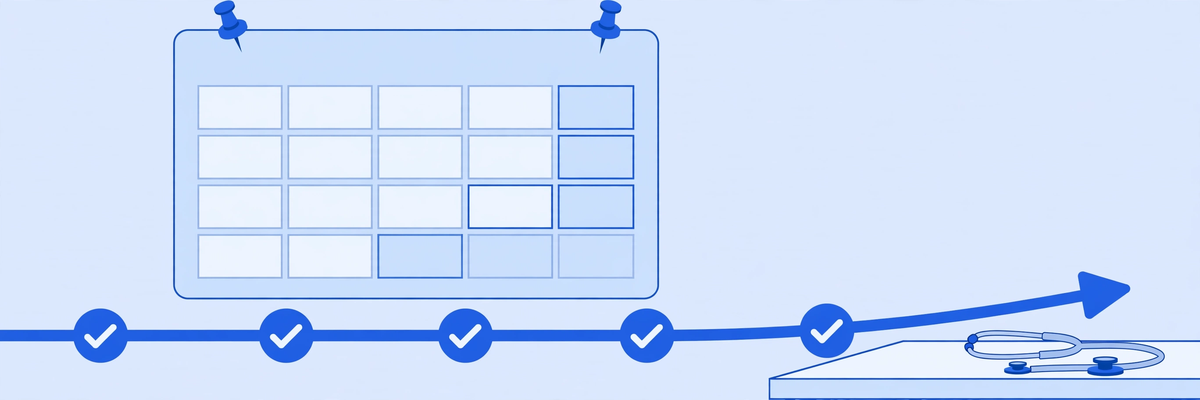
Keep one tracker for every payer: application date, documents sent, contact name, and status. Commercial plans will ask for the same documents Medicare asked for, plus the malpractice certificate, the licence, and the practice address, so keep a single dossier and reuse it. When a payer asks for more information, answer within days. A file that sits waiting for a document is a file that does not move.
- Month 1: decide the model, form the entity, apply for the EIN and the Type 2 NPI.
- Months 1 to 2: update licences, apply for DEA registration, start the business plan and the funding.
- Months 2 to 3: start payer credentialing and Medicare enrolment, sign the lease, choose the EHR.
- Months 4 to 6: fit out the space, hire and train staff, build the website and the booking flow.
- Month 6 onwards: soft open with a small schedule, fix what breaks, then open the diary fully.
Location, Equipment, and the EHR
Choose the location for access, not for prestige. Patients need parking they can find, a door they can reach without stairs or a long walk, and a waiting room that fits a family. About 2,000 square feet suits a small primary care practice, according to Physician Practice Specialists, and the rent in the published ranges runs $2,000 to $2,500 a month. Check the zoning, the signage rules, and the build-out cost before you sign, and ask the landlord who pays for the medical fit-out. A short lease with a renewal option beats a long lease signed in a hurry.
Buy equipment for the first year, not the fifth. An exam table, a diagnostic set, a fridge for vaccines, and the IT to run the practice will cover most primary care openings. Keep each purchase modest where you can, and lease what depreciates fast. The EHR decision matters more than the furniture. Choose one that fits your specialty, supports e-prescribing and labs, and connects to the portal your patients will use. Set it up before the first patient, with templates, fee schedules, and the billing codes you will actually use, because rebuilding those under a live schedule is slow and error prone. A patient portal is part of the same decision, and our article on how much a patient portal costs sets out the implementation routes and their price bands.
HIPAA Before the First Patient
HIPAA applies from the first patient, not once the practice is busy. Complete a risk assessment before opening, and fix what it finds: who can see which records, how laptops and phones are protected, and what happens if a device is lost. Our article on HIPAA risk assessment for clinics walks through the scope, the scoring, and the fix plan.
Sign a business associate agreement with every vendor that touches patient information, including the EHR, the billing service, the answering service, and the shredding company. HHS publishes sample business associate agreement provisions that show what the agreement has to cover. Use secure forms on the website, encrypt email that carries patient details, and train every new hire on the basics before they touch a record. A new practice has no old habits to unlearn, which is the best time to set the standard.
Staffing and the Front Desk
Hire in the order patients will meet people. A front desk lead first, then a medical assistant, then a biller or a billing service. A small practice can open with two or three staff if the systems are simple and the schedule is light. Train them on the phones before anything else, because the first month is mostly calls: directions, insurance questions, and appointment requests. Write down how each call should be handled, including what counts as urgent and who it goes to.
Plan for the phones to be busier than the schedule. New patients call to check the address, the insurance, and the first available appointment, and many of them call outside office hours. An AI receptionist can take those calls, book the appointment, and send a confirmation, which keeps the front desk free for the patients in the room. Decide the hours the phones are answered, and make sure someone owns the messages at the end of each day.
Finding the First Patients
Your website should be live at least a month before opening, with the address, the hours, the services, and a booking route that works. Patients search for the practice name before they call, and a page that lists the wrong number or loads slowly costs you the first visit. List the practice in the main directories with the same name, address, and phone number everywhere, and set up the Google Business Profile so the practice appears on the map when someone searches nearby.
Referrals bring the first patients faster than advertising. Introduce the practice to nearby primary care doctors, urgent care centres, and specialists, and tell them plainly what you treat and how to refer. Keep a simple record of every enquiry, every referral, and every follow-up, so nobody who asked about an appointment is forgotten. A healthcare CRM built for clinics keeps that list in one place, with the follow-up each enquiry needs.
The Opening Week, and the First 90 Days
Open with a light schedule on purpose. A half-full first week lets the team find the broken steps: the form that prints wrong, the lab order that goes nowhere, the phone message nobody answers. Fix each one the same day it appears, and keep a list. By the end of the first month, the routine should run without the owner in the room.
- Day one: walk the patient journey yourself, from the parking area to the exam room, and fix what confuses you.
- Week one: check every payer remittance, every lab result, and every message queue at the end of each day.
- Week two: review the first denials and the first no-shows, and change the process that caused them.
- Month one: hold a short team meeting on what broke, what worked, and what to change next.
- Month three: review the numbers that matter, such as visits per week, time to third available appointment, and claims paid on first submission.

Mistakes That Push Opening Day Back
Most delays come from the same few mistakes, and all of them are avoidable.
| Mistake | What happens | How to avoid it |
|---|---|---|
| Credentialing started too late | Opening day arrives with no payer contracts, so visits cannot be billed | Start credentialing in month two, before the fit-out |
| Entity and NPI left until last | Every application waits for the identifiers | Form the entity and apply for the NPI in month one |
| Lease signed before the budget | Rent and fit-out costs eat the working capital | Agree funding first, then sign the lease |
| EHR chosen in a hurry | Templates and billing codes are rebuilt under a live schedule | Choose the EHR in month three and set it up before opening |
| HIPAA treated as a later task | No risk assessment, no agreements, and staff untrained on day one | Complete the assessment and sign the agreements before the first patient |
The Bottom Line
Opening a medical practice takes six to twelve months, and the order matters more than the speed. Decide the model, form the entity, get the identifiers, and start credentialing early, because those steps run on other people's clocks. Budget honestly, keep three to six months of reserves, and open with a light schedule so the team can fix what breaks. A practice that opens quietly and runs well beats one that opens loudly and spends its first month apologising. To talk through the website, the portal, or the front desk setup for a new practice, book a demo or request a quote.

Written by Chloe Vance
Healthcare Marketing DirectorChloe Vance has led search engine optimization and digital patient acquisition strategies for top pediatric, dental, and multi-specialty clinical chains.
Frequently Asked Questions
Common conversational queries evaluated by our natural language models concerning deployment guidelines.