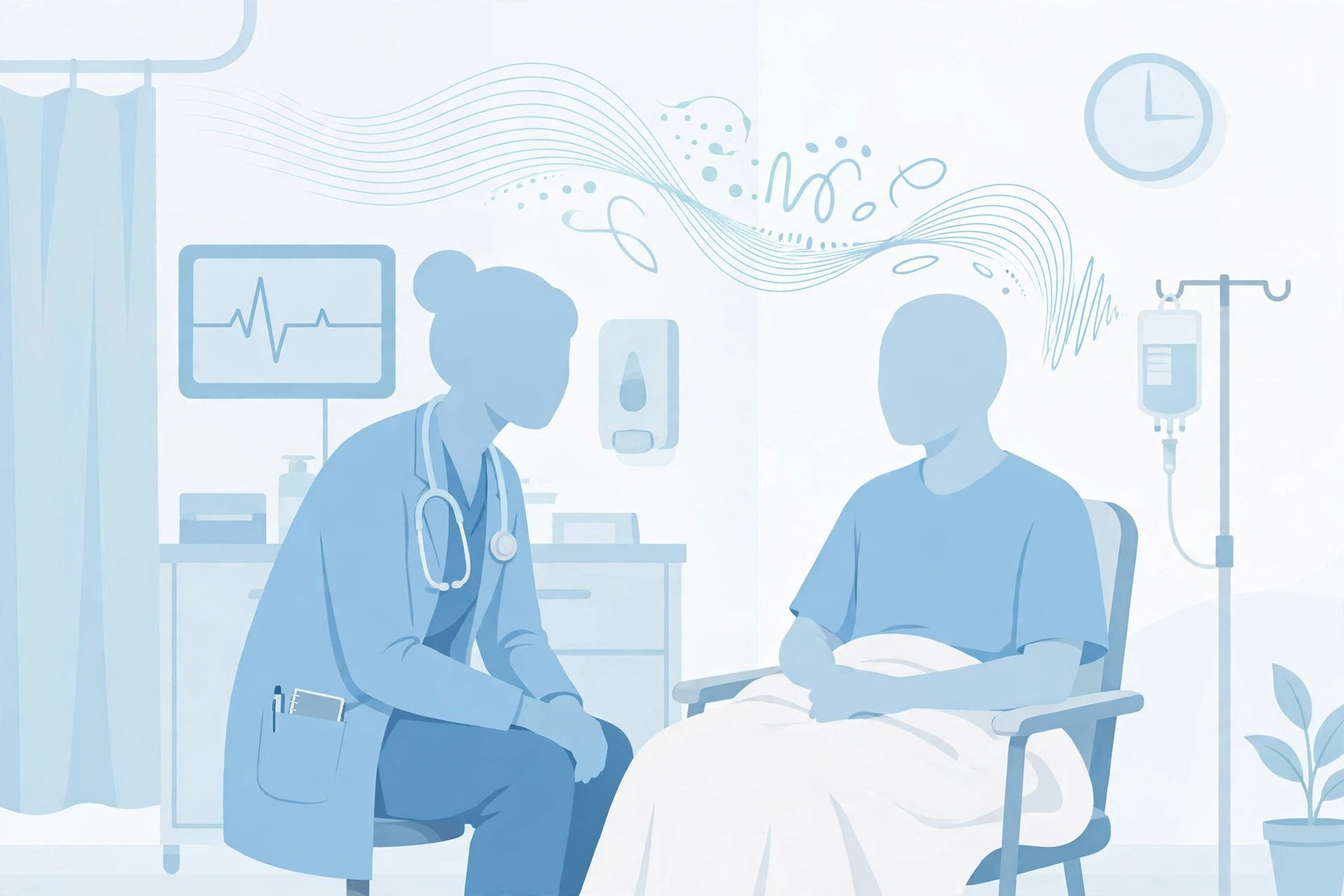
An AI tool can listen to a trauma patient's answer to one routine emergency room question and predict who is likely to develop post-traumatic stress disorder (PTSD) a month later. The tool, called PREVIA, was built by researchers at NYU Langone Health, and the study behind it was published online on 9 November 2026 in Nature Communications.
How PREVIA Works
PREVIA works from the answer to a question every emergency department already asks: 'What brought you to the ED?' The patient's spoken response is recorded and transcribed, and the tool analyses the language for early signs of PTSD risk: symptoms during the trauma, such as loss of control or gaps in memory; early symptoms in the emergency department, such as feeling disconnected from the body; risk factors such as earlier mental health problems; and protective factors such as coping skills or strong social support.
The tool is a three-layer pipeline, each layer using a different open-source language model. The first layer reads the narrative for those four dimensions. The second pulls the readings into a structured clinical summary. The third combines the summary with basic patient details and known PTSD rates, and produces a risk score with a short explanation in plain language. Because PREVIA needs no training or fine-tuning, other hospitals can test it independently without proprietary software or NYU Langone's patient data.
What the Study Found
The study followed 145 trauma survivors at two New York City level-1 trauma centres. Each patient was interviewed at the bedside within 24 hours of the trauma, and their PTSD status was assessed one month later using the Clinician-Administered PTSD Scale for DSM-5 (CAPS-5), the standard clinical interview for diagnosing PTSD. The narratives averaged about 374 words. The study was funded by the National Institute of Mental Health.
PREVIA's best configuration identified 95.4% of the patients who went on to develop PTSD, with an overall AUROC of 78.49. It also picked up subthreshold PTSD, clinically meaningful symptoms below the full diagnostic threshold, with 89.7% sensitivity. In a head-to-head test on 30 randomly selected patients, PREVIA flagged all of the patients who developed PTSD, while an emergency clinician with more than 24 years of experience identified 89% of them.
The results come with an honest limit. PREVIA's precision was moderate, so a meaningful share of flagged patients would not go on to develop PTSD. The researchers say that trade-off is right for emergency screening, where missing a case matters more than a false alarm, and a positive screen would normally lead to a brief follow-up assessment. The study is small, from two centres in one city, and the clinician comparison involved a single expert, so larger independent testing is still needed.
Why Screening in the Emergency Department Is Hard
About 43 million patients are admitted to a US emergency department each year with physical injuries, and about 27% of them develop PTSD within a month, according to past studies cited in the paper. The first month after trauma is the key window for finding those at risk, because many patients are no longer in contact with the hospital after that. Yet only about 28% of emergency departments routinely screen for PTSD at all, and only two-thirds of those use validated questionnaires.
The gap is practical, not a lack of tools. Clinicians typically have 15 to 20 minutes per patient and must put immediate medical concerns first, so a lengthy mental health questionnaire rarely fits. Stigma also makes these conversations harder to start in a busy emergency setting. A screener that works from a question already asked in routine care adds no extra time for staff or patients.
Why This Matters for Healthcare Organizations
For hospitals, the most interesting part of PREVIA is the workflow. The tool needs only a brief voice recording and a few details already in the electronic health record, and it returns a risk score with an explanation that could sit inside the record. In the study, only 6.6% of eligible participants declined because of the recording format, and the researchers say an audio-only option could lower that barrier further.
For emergency and behavioural health teams, early identification opens a window for stepped care, such as psychoeducation, brief cognitive-behavioural interventions and follow-up monitoring, when prevention is most effective. The tool also explains itself, grounding each prediction in established PTSD risk factors. But no hospital should treat this as a product yet: it is a research result, and validation in larger and more varied settings comes first.
Analysis: A Promising Signal, Not a Finished Product
PREVIA is a good example of clinical AI done in the right order: a real workflow problem, a small and well-measured study, and results reported with their limits attached. The sensitivity figure is genuinely strong for a screener built from a single open-ended answer, and the head-to-head result against an experienced clinician is striking. The design choices also help its case: open-source models, no fine-tuning, and explanations tied to known risk factors make independent testing far easier than for a closed commercial tool.
The limits are equally clear. A 145-patient study in two New York hospitals cannot say how the tool would perform in a rural emergency department or a community hospital. Moderate precision means follow-up capacity would be stretched if every flagged patient needed attention. And the headline comparison, 100% against 89%, rests on 30 patients and one clinician. What PREVIA proves today is that a patient's own words carry a usable early signal. Turning that signal into a safe, routine part of emergency care is the work still ahead.
Clinics reviewing how patient communication and follow-up work can be handled can explore MedClinicX's AI patient portal, see how after-hours calls are handled on our AI medical receptionist page, or explore the demos and request a quote. For related coverage, see our earlier article on the AMA's framework for who answers when clinical AI causes harm.
Sources and References
- NYU Grossman School of Medicine and NYU Langone Health — AI Predicts PTSD Risk Based on Stories About What Brought Patients to the Emergency Room, 9 November 2026: https://www.prnewswire.com/news-releases/ai-predicts-ptsd-risk-based-on-stories-about-what-brought-patients-to-the-emergency-room-302926212.html
- Nature Communications — LLM ensemble PREVIA predicts future PTSD risk from emergency department trauma narratives with expert-level accuracy, 9 November 2026: https://www.nature.com/articles/s41467-026-78768-3
- Medical Xpress — AI predicts PTSD risk based on stories about what brought patients to the emergency room, 9 November 2026: https://medicalxpress.com/news/2026-11-ai-ptsd-based-stories-brought.html
- Unite.AI — NYU Langone's PREVIA Flags PTSD Risk From Emergency Narratives, 9 November 2026: https://www.unite.ai/nyu-langones-previa-flags-ptsd-risk-from-emergency-narratives/
Reporting based on the sources above, accessed 9 November 2026. The NYU Langone press release and the Nature Communications paper were read directly, and the Medical Xpress and Unite.AI reports were read directly and cross-checked against them. MedClinicX did not conduct original reporting or interviews for this article. Corrections: contact us via https://medclinicx.com/contact