
Key Takeaways
- ✓A PET scan uses a small amount of radioactive tracer to show how tissues work, not just how they look.
- ✓Most PET scans need fasting for a few hours and no strenuous exercise the day before.
- ✓The scan itself takes about 20 to 45 minutes, and you need to lie still while the scanner takes pictures.
- ✓Drink plenty of water afterwards, and follow the clinic advice about close contact with others for a few hours.
- ✓Results usually take a few days, and your doctor will go through them with you at a follow-up visit.
A PET scan sounds technical, and the idea of a radioactive tracer can worry people. In practice it is a common imaging test that helps doctors see how parts of your body are working, not just how they look. Doctors use it to find cancer, to check how a treatment is working, and to look at the heart and the brain. This guide explains what a PET scan is, how it differs from other scans, how to prepare, what happens on the day, and how to handle the results.
What a PET Scan Is
PET stands for positron emission tomography. The test uses a small amount of a radioactive substance called a tracer, which is usually a form of sugar. The tracer is injected into a vein in your arm, and it travels through your body to the tissues that use the most energy. A scanner then detects the signal from the tracer and builds pictures that show how active different parts of your body are.
Cancer cells often use more sugar than normal cells, so they show up as bright spots on the scan. That is why PET scans are often used to find cancer, to see whether it has spread, and to check whether treatment is working. The test is also used to look at heart muscle after a heart attack, and to study brain activity in conditions such as epilepsy and dementia. A PET scan is often combined with a CT scan in the same visit, which gives the doctor both a functional picture and a detailed anatomical picture at once.
The tracer is made with a tiny amount of radioactive material attached to sugar, and the amount is small. It is not a dye, and it does not change the colour of anything in your body. The scanner picks up the signal the tracer gives off, and a computer turns that signal into pictures. The tracer breaks down quickly, and most of it leaves your body in urine within a few hours.
How a PET Scan Differs From Other Scans
Each type of scan shows something different, and doctors pick the one that answers their question. The table below gives a simple comparison.
| Scan | What it shows | When it is often used | Typical time |
|---|---|---|---|
| PET scan | How tissues use energy, through a tracer | Finding cancer, checking treatment, heart and brain studies | 20 to 45 minutes, plus a waiting period |
| CT scan | Detailed pictures of bones, organs, and tissues | Injuries, tumours, and internal bleeding | 10 to 30 minutes |
| MRI scan | Detailed pictures of soft tissue, brain, and joints | Brain, spine, joints, and soft tissue problems | 30 to 60 minutes |
| X-ray | Simple pictures of bones and chest | Broken bones and chest problems | A few minutes |
A PET scan does not replace the other scans. It answers a different question, about how tissues behave, while a CT or MRI shows shape and structure. Your doctor may order more than one type of scan, since each one adds a piece to the picture. Our guide on preparing for a CT scan explains what to expect if your PET scan is combined with a CT scan in the same visit.
How to Prepare
Preparation is simple, but it matters. The tracer works best when your blood sugar is steady, so the clinic will give you exact instructions when you book. These are the steps most patients need to take.
- Fast for about four to six hours before the scan, as your clinic advises, and drink plain water only
- Avoid strenuous exercise and heavy physical work the day before, since muscle activity affects the tracer
- Tell the clinic about every medicine you take, and ask whether to take it as normal on the day
- If you have diabetes, tell the clinic when you book, since your blood sugar needs checking before the scan
- Tell the clinic if you are pregnant, breastfeeding, or think you might be pregnant
- Wear loose, comfortable clothes with no metal zips or buttons, and leave jewellery at home
- Bring your insurance card, a photo ID, and a list of allergies
If you feel unwell on the day, or you ate by mistake during the fasting period, call the clinic before you travel. The scan may need to be moved, since a scan done at the wrong blood sugar level can give unclear images. Ask how long the visit should take, so you can plan your day around it.
What Happens on the Day
When you arrive, the team will check your details, your medicines, and your allergies, and may check your blood sugar with a finger prick. You will then be given the tracer through a small injection in your arm. The injection feels like a normal blood test, and most people feel nothing from the tracer itself.
After the injection you wait for about 45 to 60 minutes while the tracer spreads through your body. You will rest in a quiet room, and you should stay still and relaxed during this time. You may be asked not to talk much or move around, since muscle activity can affect where the tracer goes. The team may offer you a blanket, since the waiting room is often kept cool.
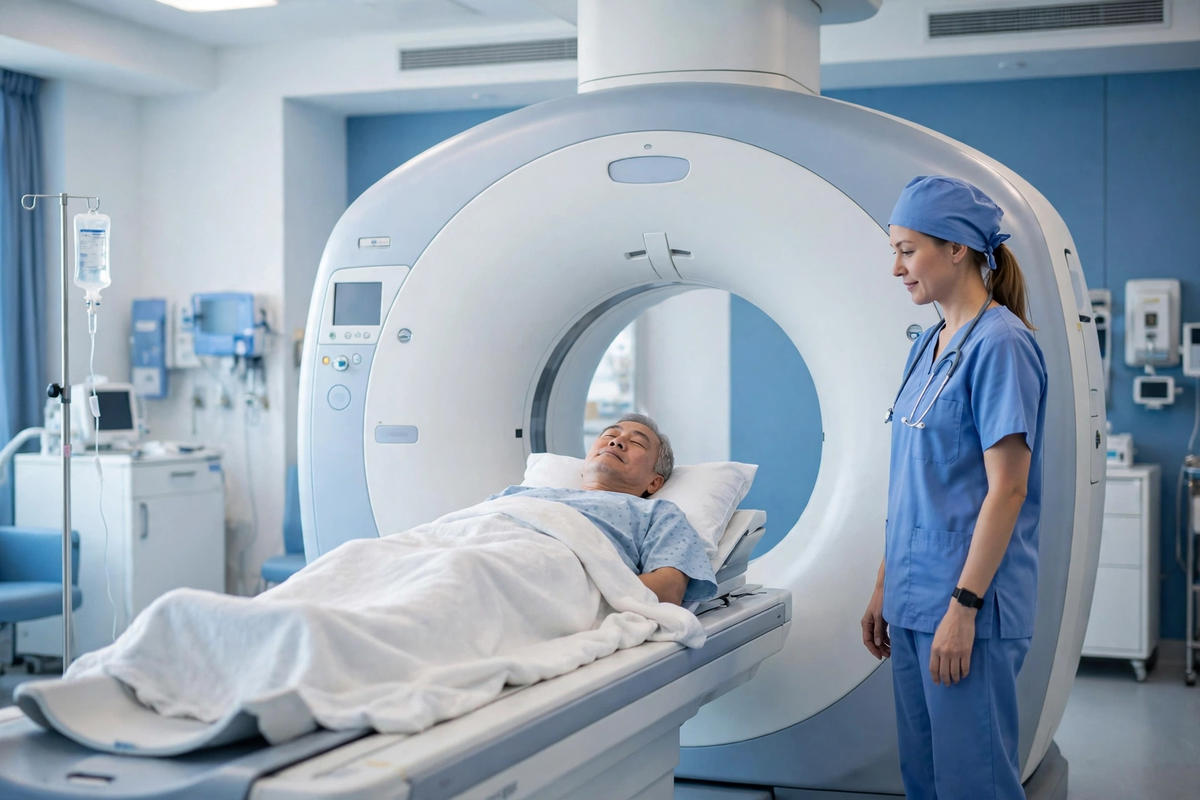
For the scan itself you lie on a table that slides into the scanner, which looks like a large ring or tunnel. The scan takes about 20 to 45 minutes, and you need to lie still while the scanner takes pictures. The machine is quieter than an MRI scanner, and the team talks to you through a speaker during the scan. If the scan is combined with a CT scan, that part takes only a few minutes more.
If you feel anxious or uncomfortable
Tell the team before the scan if you feel anxious in small spaces, if you have trouble lying still, or if you have pain that makes lying flat hard. They can help with positioning, blankets, or medicine to help you relax. If you feel unwell at any point during the visit, say so right away.
After the Scan
When the scan is done, you can get up and go home. Drink plenty of water during the rest of the day, since that helps your body clear the tracer faster. The clinic may advise you to avoid close contact with pregnant people and small children for a few hours, since you carry a small amount of radiation until the tracer leaves your body. Follow the exact advice the clinic gives you, since it depends on the tracer dose.
You can eat and drink normally after the scan unless the clinic tells you otherwise. Most people feel fine and go back to normal activities the same day. If you were given medicine to help you relax, you should rest at home and not drive. Our guide on how to get your medical records explains how to keep copies of your scan reports once they arrive.
If your scan was combined with a CT scan that used contrast dye, the team may ask you to drink extra water and watch for a reaction. Tell the team if you feel itchy, develop a rash, or feel unwell after the visit. These reactions are uncommon, but the team would rather hear from you early than have you wait and worry at home.
Understanding Your Results
A specialist doctor reads the images and writes a report, which goes to the doctor who ordered the scan. The report describes where the tracer collected, and what that pattern suggests. Bright spots may point to cancer, infection, or inflammation, but the result needs a doctor to interpret it in the context of your symptoms and other tests. A bright spot alone does not prove a diagnosis.
Your doctor will go through the report with you at a follow-up visit, by phone, or through the patient portal. Ask what the result means for your care, and what the next steps are. If the result is unclear, the doctor may order more tests. If cancer is found, the report helps the team plan treatment. Our guide on how to choose an oncologist explains how to find a cancer specialist, and our guide on getting a second opinion explains when to ask for another view.
Risks and Safety in General Terms
A PET scan uses a small amount of radiation, and the dose is low. The tracer leaves your body within hours, mostly through urine. The risk from one scan is small, and doctors order the test only when the information it gives is worth that small risk. Allergic reactions to the tracer are rare, and the team watches for any reaction after the injection.
Tell the clinic if you are pregnant or breastfeeding, since the scan is usually avoided or postponed in pregnancy, and breastfeeding may need a short pause after the scan. Tell the team about any allergies, and about any other scans or treatments you have had recently. If you have any worries about radiation, ask the doctor to explain the dose and why the scan is needed for your care.
Insurance and Costs in General Terms
Most plans cover a PET scan when a doctor orders it, but many plans need prior authorization first, so ask the clinic to check your coverage before the day. The cost can come in separate parts: the tracer, the scan itself, and the reading of the result. Ask what you will owe for each part, and whether the imaging center is in your network, since an out-of-network center can add to the bill.
If you are uninsured or the cost is a worry, ask the clinic about payment options before the scan. Some imaging centers offer a payment plan, and some have assistance programs. Our guide on understanding your health insurance plan explains how to check what your plan covers, and our guide on understanding your lab test results explains how to read the reports that follow a scan.
Questions Worth Asking
Write your questions down before the visit, so you leave with clear answers. These are a good starting set.
- Why do I need a PET scan, and what will the result tell us?
- How long do I need to fast, and can I drink water?
- Should I take my regular medicines on the day of the scan?
- How long will the whole visit take, including the waiting period?
- Will the scan be combined with a CT scan, and what does that add?
- When will I get the results, and how will they reach me?
- What should I do after the scan, and are there any contact limits?
If an answer is unclear, say so and ask the doctor or the imaging team to explain it again in simpler terms. Knowing what to expect takes much of the worry out of the day.
Preparing for a PET scan is mostly about following a few simple steps: fast as advised, rest before the scan, lie still during it, and drink plenty of water afterwards. The test itself is painless, and the waiting period is the longest part of the visit. If your clinic wants an easier way to handle bookings, results, and patient messages, you can request a quote from Med Clinic X and see what fits your practice.

Written by Chloe Vance
Healthcare Marketing DirectorChloe Vance has led search engine optimization and digital patient acquisition strategies for top pediatric, dental, and multi-specialty clinical chains.
Frequently Asked Questions
Common conversational queries evaluated by our natural language models concerning deployment guidelines.