
Key Takeaways
- ✓A CT scan is a quick imaging test that uses X-rays to build detailed cross-sectional pictures of the inside of the body.
- ✓Some scans need fasting or contrast dye, while others need no preparation at all, so follow the instructions from your imaging centre.
- ✓Tell the staff about allergies, kidney problems, diabetes medicines, and possible pregnancy before the scan starts.
- ✓The scan itself is painless and usually takes only a few minutes, though you need to lie still while the images are taken.
- ✓Results are read by a radiologist and sent to the doctor who ordered the scan, usually within a few working days.
A CT scan can sound daunting the first time your doctor orders one. The machine looks large, the word radiation raises questions, and you may not know whether you need to fast, change your medicines, or arrange a ride home. In practice, most CT scans are short, painless and straightforward, and a little preparation makes the day easier.
This guide is written for a patient who has a CT scan booked, not for a clinic. It explains what a CT scan is, why your doctor orders one, how to prepare, what contrast dye does, what happens during the scan, and what comes after. If you are preparing for a different scan, our guide on preparing for an MRI scan covers that test, and our guide on how to get your medical records explains how to keep copies of your results in one place.
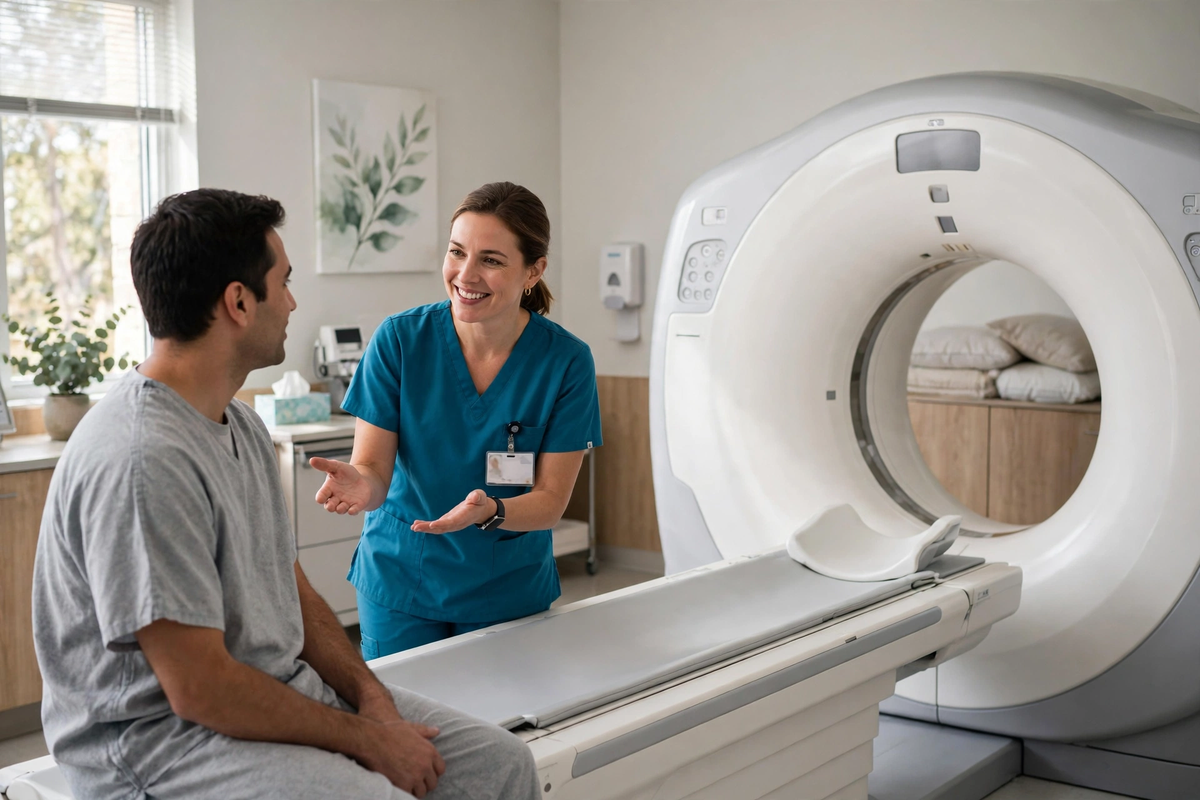
CT stands for computed tomography. A CT scanner is a large ring-shaped machine with an X-ray tube that rotates around you while you lie on a table that slides through the ring. The scanner takes many X-ray pictures from different angles, and a computer combines them into cross-sectional images, like slices through the body. A doctor can look at one slice at a time or view the images as a three-dimensional picture.
The images show far more detail than a plain X-ray. Bones, blood vessels, lungs, liver, kidneys and other organs can all be seen clearly, which is why CT scans are used for so many different problems. The scan itself usually takes only a few minutes, though the whole appointment, including preparation and waiting, often takes longer.
CT is not the only imaging test, and it is not always the right one. An MRI scan uses magnets instead of X-rays and gives different detail, especially for soft tissues such as the brain and spinal cord. An ultrasound uses sound waves and involves no radiation at all. Your doctor chooses the test that answers the question best, and cost, speed and your medical history all play a part in that choice.
Doctors order CT scans for many reasons. A scan can show whether an injury has damaged a bone or an organ, whether an infection has spread, whether a lump is present and how large it is, or whether a treatment is working. It can also guide a procedure, such as a biopsy, by showing exactly where a needle should go.
Common reasons include checking for a fracture after an accident, looking for the cause of abdominal pain, finding a blood clot in the lungs, checking the sinuses, or following up on a condition found on an earlier test. In an emergency, CT is often the first scan because it is fast and widely available, and the images are ready within minutes.
A CT scan does not give a diagnosis on its own. It gives your doctor information to combine with your symptoms, your examination and your other test results. If the scan shows something unclear, your doctor may order another test to look closer, and that is a normal part of the process rather than a sign that something is wrong.
Preparation depends on the type of scan. Some CT scans need no preparation at all. Others ask you to fast for a few hours, to drink water before you arrive, or to take a contrast liquid at home or at the centre. Your instruction letter or the imaging centre will tell you exactly what to do, and following those instructions matters, because the wrong preparation can mean the scan has to be repeated.
A short checklist covers most scans.
- Read your instruction letter when it arrives, and call the centre if anything is unclear
- Wear comfortable clothes without metal zips, buttons or hooks, or be ready to change into a gown
- Leave jewellery, watches, glasses, hearing aids and hairpins at home or in a locker
- Bring a list of your medicines, including diabetes medicines, and any allergy information
- Bring your referral letter, insurance card and photo ID
- Tell the staff if you might be pregnant, or if there is any chance you are
- Arrange a ride home if you are having sedation, or if you feel unwell after contrast
- Arrive a little early, since the centre may ask you to fill in a short safety form
If you take metformin or another diabetes medicine, mention it when you book. Some centres ask you to pause it around a contrast scan, but do not stop any medicine on your own. Ask your doctor or the centre what to do, and take the advice that fits your situation.
Some CT scans use a contrast dye, also called contrast material, to make certain tissues and blood vessels show up more clearly. It is usually given through a small needle in a vein in your arm, and sometimes as a liquid you drink or as an enema for scans of the bowel. The dye contains iodine, which shows up brightly on X-rays.
Most people feel little more than a warm flush through the body or a metallic taste in the mouth for a minute or two. These feelings pass quickly. A small number of people have an allergic reaction, which is why the staff ask about past reactions to contrast dye, allergies in general, and kidney problems before the scan. If you have had a reaction before, tell them, since they may use a different plan or give medicine beforehand.
After a contrast scan, drinking extra water for the rest of the day helps your kidneys clear the dye. The staff will tell you how much to drink and whether any of your medicines need a short pause. If you develop a rash, swelling, itching or trouble breathing after you leave, seek care promptly and tell them you had a contrast scan.
When you arrive, the staff will check your details, your safety form and your instructions. You may be asked to change into a gown and to remove metal objects. If your scan uses contrast through a vein, a nurse will place a small needle in your arm before you lie down.
You will lie on your back on a narrow table, which slides into the ring of the scanner. The staff may place a strap or a cushion to help you stay still, and they will ask you to keep your arms in a set position. The scanner is open at both ends, and you can see out, which helps if you feel uneasy in enclosed spaces. Tell the staff if you feel nervous, since they can talk you through it.
During the scan, the table moves slowly while the X-ray tube rotates around you. You will hear a quiet whirring sound. The radiographer, the person running the scanner, watches from the next room and speaks to you through an intercom. You may be asked to hold your breath for a few seconds while an image is taken, then to breathe normally again. The scan itself is painless, and most scans finish within a few minutes.
When the scan is finished, the table slides back out and the staff help you sit up. If you had contrast through a vein, the needle is removed and a small dressing is placed over the spot. Most people go home straight away and return to normal activities the same day.
| Step | What happens | When |
|---|---|---|
| Contrast through a vein | Needle removed, small dressing applied | Straight after the scan |
| Drinking water | Extra fluids to help clear the dye | For the rest of the day |
| Results read | A radiologist reads the images and writes a report | Usually within a few working days |
| Doctor contacts you | Your doctor explains the results and the next step | When the report arrives |
| Follow-up tests | A closer look if the images need it | Only if your doctor orders one |
If you had sedation for the scan, you will need someone to take you home, and you should not drive for the rest of the day. Sedation is uncommon for CT scans, but it is sometimes used for children or for patients who cannot lie still. The centre will tell you in advance if sedation is planned.
Your images are read by a radiologist, a doctor who specialises in medical imaging. The radiologist writes a report and sends it to the doctor who ordered the scan. The timing depends on the centre and how urgent the question is, but many routine results arrive within a few working days.
Ask before you leave who will contact you, when to expect the call, and what to do if you have not heard anything by then. If the result is normal, your doctor may simply confirm that no further action is needed. If the scan shows something that needs attention, your doctor will explain what it means and what happens next, which may be another test, a referral to a specialist, or a change in treatment.
Keep a copy of your report with your other medical records. Our guide on understanding your lab test results explains how to read a report without getting lost in the technical language, and our guide on getting a second opinion walks through what to do when a result leaves you with questions.
A few questions before or after the scan can clear up most worries. Ask them when you book, when you arrive, or when your doctor calls with the results.
- Do I need to fast, and for how long before the scan?
- Will this scan use contrast dye, and how will it be given?
- Should I change any of my medicines before or after the scan?
- How long will the scan itself take, and how long will I be at the centre?
- When will my doctor have the results, and who will call me?
- What should I do if I feel unwell after the scan?
A CT scan is a tool, not a verdict. It gives your doctor a clear picture to work with, and most scans end with a simple next step. Prepare as instructed, tell the staff what they need to know, and ask your questions while you are there.
A CT scan is quick, painless and routine
Most people walk out of a CT scan wondering why they worried. The machine is quick, the staff do this every day, and the hardest part is usually lying still for a few minutes. Go in prepared, and the rest takes care of itself.
If you have a CT scan coming up, read your instruction letter, follow the preparation steps, and call the imaging centre if anything is unclear. A short call before the day saves a repeat visit. If you would like help finding a practice near you, get a quote from Med Clinic X and we can point you in the right direction.

Written by Chloe Vance
Healthcare Marketing DirectorChloe Vance has led search engine optimization and digital patient acquisition strategies for top pediatric, dental, and multi-specialty clinical chains.
Frequently Asked Questions
Common conversational queries evaluated by our natural language models concerning deployment guidelines.