Key Takeaways
- ✓Patient education is not handing over a leaflet. It is making sure the patient can explain, in their own words, what to do next.
- ✓Start with what the patient already knows and worries about, and teach only the points that change a decision or a behaviour.
- ✓Plain language, short sentences and one idea at a time beat long explanations full of medical terms.
- ✓Teach-back is the simplest check that learning happened, and it should test the explanation, never the patient.
- ✓Reinforce learning after the visit with a written summary, a portal message or a follow-up, because most forgetting happens at home.
A patient leaves the clinic with a diagnosis, a plan and a head full of new words. By the time they reach home, much of what was said has blurred, and the questions they were too nervous to ask have finally arrived. That gap, between what the clinic said and what the patient understood, is where treatment plans quietly fail. Patients do not ignore advice out of stubbornness. Most often, they never understood it clearly enough to follow it, or they understood it differently from how it was meant.
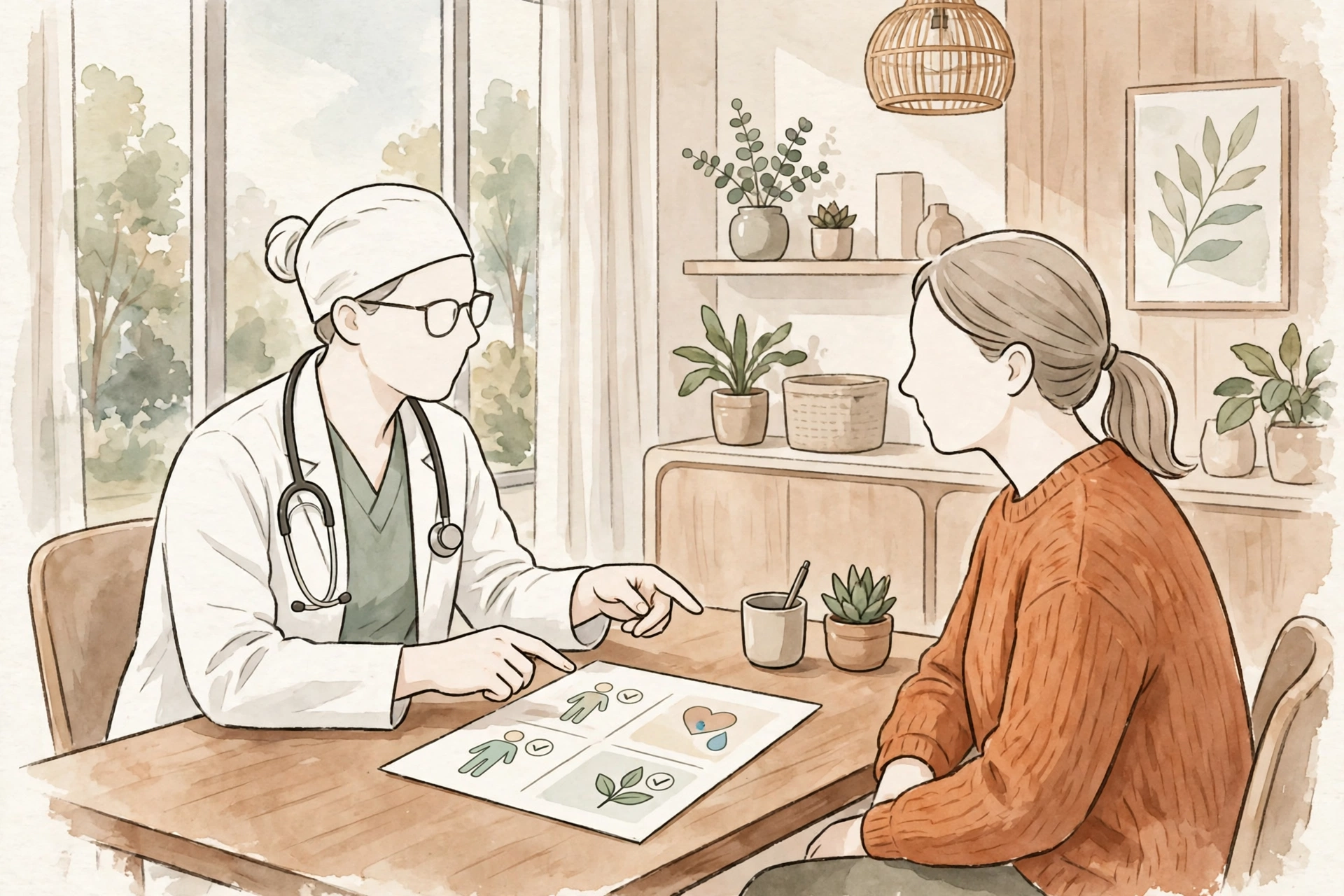
Patient education is the clinic's work of closing that gap. It is not a leaflet handed over at the desk, and it is not a lecture delivered at speed. It is the habit of explaining conditions and treatment in plain language, checking that the patient understood, and giving them something useful to take home. This guide shows how a busy clinic can do that well: what to teach, how to say it, how to check understanding, and how to reinforce learning after the visit. The reward is practical, not abstract: patients who understand their care follow it better, ask better questions, and worry less.
What Patient Education Really Means
Patient education covers everything a clinic teaches a patient about their health: what a condition is, what a treatment does, how to take medicine, what to watch for, and when to come back. It happens in the consulting room, at the front desk, in a printed handout, in a portal message, and in a follow-up call. The best clinics treat it as part of care, not as an extra, because a plan a patient does not understand is a plan that will not be followed, however good the clinical decision behind it was.
Education is also a two-way job. A patient who feels talked at will nod politely and leave confused, while a patient who is invited to ask questions will reveal the misunderstanding that matters. A clinician who asks what the patient already knows, what they have tried, and what worries them will teach far more effectively than one who starts from the beginning every time. The goal is not to cover everything, but to make sure the patient leaves knowing what to do, why it matters, and what to do if something goes wrong.
Start With What Patients Actually Ask
Every clinic already knows what its patients ask, because the same questions arrive every week: will this hurt, how long will it take, what happens if I do nothing, and what should I watch for? Those questions are the education curriculum, and a clinic that answers them well, in plain language, will cover most of what patients need. Keep a running list of the questions patients actually ask, and build handouts and portal messages around those questions rather than around what the clinic thinks patients ought to know.
Asking first also prevents wasted teaching. A patient who has lived with a condition for years does not need the basics repeated, and a patient who is frightened by one specific outcome does not need a general lecture. A short opening question, such as what concerns you most about this, will focus the whole conversation. It also shows respect: the patient is not an empty vessel to fill, but a person with knowledge, fears and experience that the clinic should build on.
Plain Language: Writing Patients Can Use
Plain language is not dumbing down. It is writing so that a tired, worried person can understand it the first time. Short sentences help, and so does one idea at a time. Medical terms should be explained the first time they appear, or replaced with an everyday word when one exists. A patient who hears a diagnosis in words they do not know will spend the rest of the visit translating, instead of listening to what comes next. If a term must be used, say it, explain it in a sentence, and then use the plain word afterwards.
| Instead of this | Try this | Why it works |
|---|---|---|
| You have hypertension | Your blood pressure is high | Names the problem in everyday words |
| Take this medication twice daily | Take one tablet in the morning and one in the evening | Says exactly when, not just how often |
| Monitor for adverse effects | Watch for these warning signs, and call us if you notice them | Tells the patient what to do, not just what to fear |
| Your prognosis is favourable | Most people with this condition do well with treatment | Answers the question the patient is actually asking |
| Adhere to the regimen | Keep taking the tablets as described, even when you feel better | Explains the behaviour, not just the rule |
Teach-Back: Checking Understanding Without a Test
Teach-back is the simplest, cheapest check a clinic has, and it takes about a minute. After explaining a plan, the clinician asks the patient to explain it back in their own words. The wording matters: it should test the explanation, not the patient. A good version is: I want to check I explained this clearly, so could you tell me how you will take this medicine at home? If the patient struggles, the clinician re-explains, differently, and checks again. No blame, no embarrassment, and no patient left pretending to understand.
Teach-back works because nodding is not understanding. Patients nod for many reasons: politeness, embarrassment, a wish to leave, or a belief that they understood when they did not. A clinician who relies on a nod will discover the misunderstanding only when the patient returns, or does not return at all. Teach-back should be used most carefully for the highest-stakes instructions: how to take a new medicine, how to prepare for a procedure, and which warning signs mean calling the clinic promptly.
Education at Every Step of the Visit
Education should not be saved for the last two minutes of a visit, when the patient is already thinking about the car park. It works better spread through the visit: a brief explanation before an examination, a check of understanding during the discussion, and a summary at the end. Front desk staff have a part too. A receptionist who explains what happens next, what to bring, and how long a visit will take is doing patient education, and doing it at the moment the patient most needs it. The clinic front desk operations guide covers those daily workflows in more detail.
End every visit with a written summary
The end of the visit deserves a summary, not a rush. Two or three sentences that repeat the diagnosis in plain words, the plan, and the warning signs will do more than a long closing speech. Give that summary in writing as well, because memory fades fast after a visit, especially when the news was worrying. A patient who leaves with a short written summary, in plain language, has something to check at home, something to show family, and something to bring to the next visit.
Printed Handouts, Portal Messages and Video
Different patients learn in different ways, so a clinic needs more than one format. A printed handout suits a patient who wants to read slowly, show family, or stick a summary on the fridge. A portal message suits a patient who wants to check details later, and a short video suits a patient who learns by watching a step done. The clinic's patient portal is a natural home for education material, because patients can return to it when the question actually arises, which is usually at home, not in the clinic.
Whatever the format, the same rules apply. Keep it short, in plain language, and focused on what the patient does next. A handout that tries to explain everything about a condition will be skimmed and filed, while a one-page summary of the plan, the medicine routine and the warning signs will be used. Check every handout by reading it as a patient would: tired, worried, and in a hurry. If it cannot be understood in that state, it is not finished. For clinics building their portal from scratch, the patient portal implementation guide covers how to structure content patients can actually find.
Education for Different Needs: Language, Literacy and Access
Not every patient reads well, speaks the clinic's language fluently, or learns comfortably from text. A clinic that only teaches in writing will leave some patients behind, and will never know which ones, because those patients are the least likely to say so. Offer material in the languages the clinic's patients actually speak, use pictures and diagrams where they help, and always offer to explain aloud as well as in writing. Never assume that a patient who nods at a handout can read it.
Access matters too. A patient without a smartphone, without email, or without confidence using either should never be left with only a digital link. Offer a printed version as standard, and check that the patient can open anything sent digitally before relying on it. Family members and carers can help, but only with the patient's agreement, and the clinic should check what the patient themselves understood, not only what a relative understood. Good education reaches the patient, not just the patient's household.
Following Up: Reinforcement After the Visit
Most forgetting happens after the visit, so the best education continues at home. A short follow-up message a day or two later, repeating the key steps and inviting questions, reinforces learning at exactly the moment questions arrive. A brief call after a new medicine starts, or after a procedure, can catch misunderstandings while they are still easy to fix. Short, useful messages work best here, and the same care that makes patient texting effective, short, personal and genuinely useful, applies to education follow-up too.
Follow-up is also a chance to learn what the clinic got wrong. If several patients ask the same question after a visit, the original explanation probably missed something, and the handout or portal message should be fixed. Clinics that treat follow-up questions as feedback, rather than as extra work, steadily improve their education material. Over time, the questions patients ask after visits become fewer and sharper, which is a good sign that the teaching is landing.
Mistakes That Make Education Useless
The most common mistake is teaching too much at once, which guarantees that little of it is remembered. The second is using medical language without explanation, which leaves patients translating instead of listening. The third is handing over material without checking understanding, which leaves the clinic confident and the patient confused. The fourth is relying on a single format, usually a leaflet, that some patients cannot use. And the fifth is treating education as a one-time event, with no follow-up, so that learning fades before it is ever used.
A related mistake is blaming the patient when teaching fails. A patient who does not follow a plan they did not understand has not failed. The explanation has. Clinics that accept that, and fix the explanation instead of repeating it, will see better results than clinics that label patients as non-compliant. Education is a clinic skill, not a patient test, and it improves with the same discipline as any other clinical skill: practice, feedback, and honest review.
Measuring Whether Patients Understand More
A clinic can measure education without a formal study. Ask patients, during follow-up, whether they understood their plan and what they would still like explained. Track how often teach-back reveals a misunderstanding, and which topics reveal it most, because those topics need better material. Watch for practical signs too: fewer calls asking questions already answered in the handout, fewer missed doses reported at follow-up, and patients who arrive at the next visit able to describe their plan. Those signs, taken together, show whether education is working.
Review the material regularly, not just when someone complains. A handout written years ago may use terms the clinic no longer uses, or miss a step the clinic now recommends. Assign one person to review education material on a regular rhythm, and to retire anything out of date. Done well, patient education is quiet work with a visible payoff: patients who know what to do, why it matters, and when to call. That is not a soft benefit. It is the difference between a plan that is prescribed and a plan that is followed. To see how education fits into a wider patient experience, read the patient recall guide, and if the clinic is ready to explore its options, the team can book a demo.
Written by Chloe Vance
Healthcare Marketing DirectorChloe Vance has led search engine optimization and digital patient acquisition strategies for top pediatric, dental, and multi-specialty clinical chains.
Frequently Asked Questions
Common conversational queries evaluated by our natural language models concerning deployment guidelines.