
Key Takeaways
- ✓We counted all 323,397 listings in the Med Clinic X directory on 11 November 2026, across 14 specialties and all 50 states plus Washington, DC.
- ✓Every listing carries a phone number, but only 2.0 percent carry a website address, because the national registry most listings are built from does not collect websites.
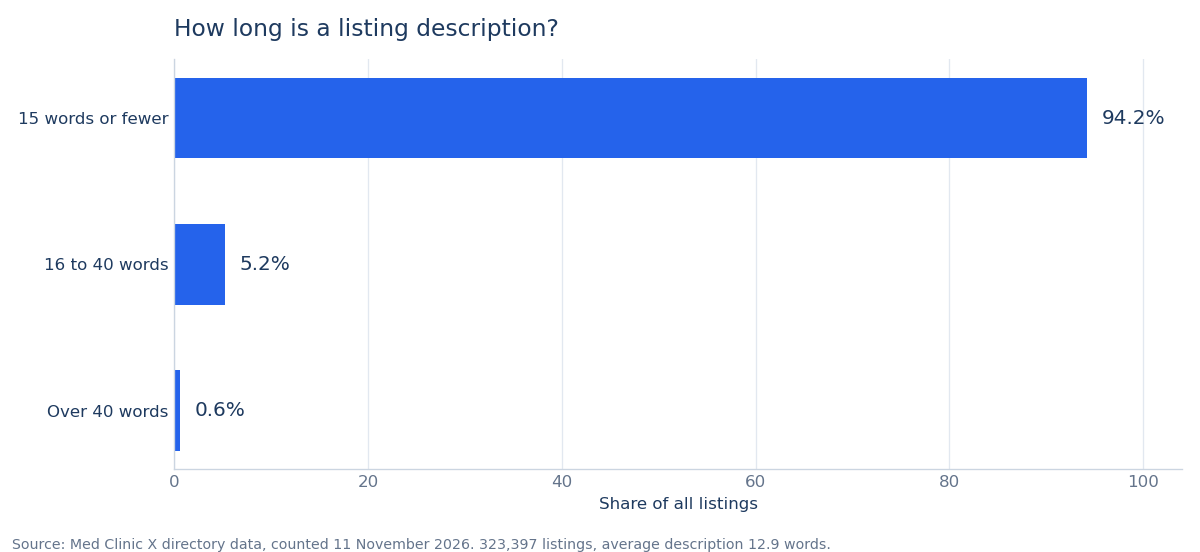
- ✓94.2 percent of listings describe the practice in 15 words or fewer. The average description is 12.9 words.
- ✓The 6,401 listings checked against each practice's own website average 36.5 words of description, and every one carries a website address.
- ✓The figures describe listings, not practice quality or patient demand. A thin listing is a data gap a practice can close, not a judgement on the practice.
Med Clinic X runs a directory of US healthcare practices, and on 11 November 2026 we counted every listing in it: 323,397 practices across all 50 states and Washington, DC. Then we looked at what those listings actually hold. The short version is that a typical listing is thin. Every listing carries a phone number. Only 2 in 100 carry a website address. And 94 in 100 describe the practice in a single sentence of 15 words or fewer, with the average description running 12.9 words.
This article sets out what we counted, how we counted it, and what the gaps mean for a practice that wants to be found. Every figure comes from the directory's own data files, and the method is described at the end. The numbers describe listings in this directory. They say nothing about how good a practice is, how busy it is, or what patients in its town are searching for.
We are publishing the count because the directory is ours. Most published numbers about how practices appear online come from surveys or from samples drawn from other people's data. This one comes from a dataset we hold, maintain and can count in full, and anyone who wants to test it can compare our figures against the listings themselves, which are public. Where the data makes our own directory look unfinished, we have said so, because some of it does.
The Shape of the Directory
The directory covers 14 specialties. Dentists are the largest group at 63,268 listings, just under 20 in every 100. Primary care follows at 56,543, about 17 in 100, then physical therapy at 40,371 and mental health at 36,252. Between them, dentists, primary care and physical therapy account for 160,182 listings, very nearly half the directory. At the other end, cardiology holds 6,744 listings and dermatology 4,586, just over 1 in 100. The spread mostly reflects how many practices of each type exist and how the national registry classifies them. A specialty with fewer listings is not a specialty with less demand.
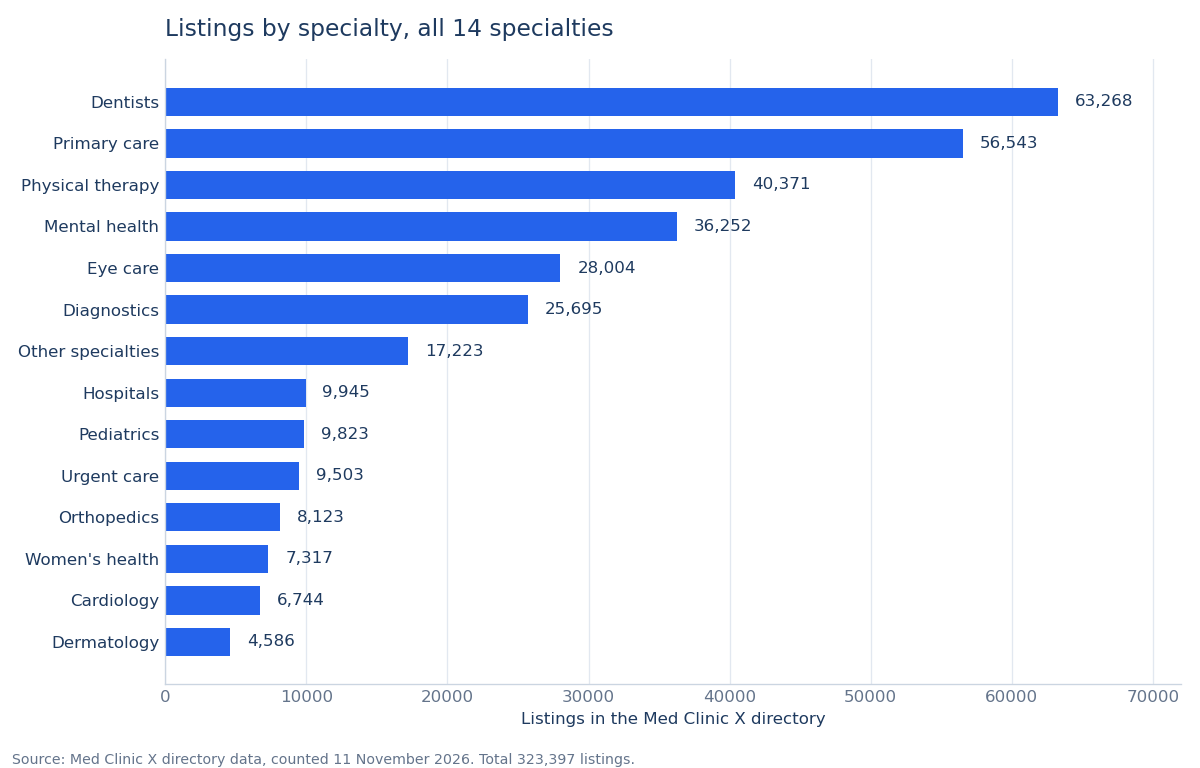
One caution belongs here. Each listing sits under a single specialty in this directory, the one its registry record points to. A practice that offers both primary care and urgent care appears once, under one heading. The counts show how the directory is organised, not how many services each practice provides.
Two of the 14 headings are broad by design, and their size needs that context. Diagnostics, at 25,695 listings, covers diagnostic laboratories and medical imaging centers rather than clinics a patient books with directly. The group labelled other, at 17,223, holds legitimate healthcare providers and clinics that do not fit the 13 named headings. Neither figure is comparable with a heading like dentists or pediatrics, and we have kept them in the chart because leaving them out would misstate the directory's size.
Where the Listings Sit
Listings follow population, broadly. Florida holds 30,684, California 30,067 and Texas 26,358. Together those three states account for 87,109 listings, more than a quarter of the directory. New York and Illinois complete the top five, and the five together hold 118,350 listings, over a third of the total. A few thousand listings sit in US territories, most of them in Puerto Rico at 3,252.
| State | Listings | Share of directory |
|---|---|---|
| Florida | 30,684 | 9.5% |
| California | 30,067 | 9.3% |
| Texas | 26,358 | 8.1% |
| New York | 18,221 | 5.6% |
| Illinois | 13,020 | 4.0% |
| Pennsylvania | 11,622 | 3.6% |
| Michigan | 10,614 | 3.3% |
| New Jersey | 10,358 | 3.2% |
At the small end, Vermont holds 639 listings, North Dakota 743 and Wyoming 868. Those numbers track how many people live in each state, and they carry a practical point for anyone reading them as a market signal. A state with few listings is a state with few practices, not a state with an opening waiting to be taken. Directory counts describe supply that is already listed, nothing more.
A second caution applies to anyone tempted to rank states by opportunity. These are raw counts, not rates. We have not divided them by population, by the number of patients, or by anything else, because those figures come from outside this dataset and this article sticks to what we counted. Florida's 30,684 listings and Vermont's 639 mostly reflect the difference in how many people, and therefore how many practices, each state has. Reading more into the gap than that would be inventing a finding the data does not hold.
What a Typical Listing Holds
Every one of the 323,397 listings carries a phone number. That is the one field the directory never lacks. Beyond it, the picture thins out quickly. A website address appears on 6,406 listings, which is 2.0 percent. A public email address appears on about 2 in every 1,000.
The reason sits with the source. Most listings, 316,992 of them, were built from the US NPPES registry, the national register of healthcare providers. The registry records a practice's name, address, phone number and type. It does not collect website addresses, and it does not hold a written description a practice has composed about itself. A listing built from registry data therefore starts with the facts the registry keeps, and nothing else. A missing website on a listing does not mean the practice has no website. In most cases it means nobody has added it yet.
For comparison, a completed listing on this directory can hold much more:
- The practice's website address and a public email address
- A written description in the practice's own terms, covering services and the patients it serves
- Opening hours and the full street address, with the phone number the registry already supplies
- A note of when the listing was last checked, and against what source
Almost none of that fuller record exists yet at directory scale. The fields are there. They are simply empty for most practices, because the source data never filled them and the checking work that fills them is slow, one practice at a time.
One Sentence Is the Norm
Descriptions tell the same story. The average listing description runs 12.9 words. Just over 94 percent of listings, 94.2 percent, carry a description of 15 words or fewer. Most of those follow one pattern, a single sentence that gives the practice name, its type and its city and state. Only 0.6 percent of listings carry a description longer than 40 words.
A sentence like that is accurate, and it is not much to work with. It tells a reader where the practice is and what kind of practice it is. It says nothing about the services offered, the conditions treated, the languages spoken, or how a new patient books. Those are the details a person comparing two practices nearby usually wants, and they are the details a search engine or an AI assistant needs before it can describe a practice in its own words.
Thin in Every Specialty
The pattern is not confined to one corner of the directory. Leaving hospitals aside for a moment, the average description in every specialty runs between 11.4 and 13.7 words. Among dentists, the largest group, 98.5 percent of listings carry a description of 15 words or fewer. Pediatrics stands at 98.7 percent, cardiology at 98.4 percent. The website gap is just as even. Of 63,268 dental listings, 6 carry a website address. Of 56,543 primary care listings, 3 do. Of 40,371 physical therapy listings, 2 do.
Hospitals are the exception that shows the rule. Their listings average 23.7 words of description, and 5,263 of 9,945 hospital listings carry a website. That is not because hospitals write better listings. It is because the hospital group is where our checking work started, so most hospital listings have already been compared against the practice's own website. Mental health, the second group checked, sits between the two patterns: 1,100 of its 36,252 listings carry a website. Everywhere the checking has not reached, the registry pattern holds almost untouched.
What a Checked Listing Looks Like
A smaller part of the directory has been checked against each practice's own website, listing by listing. That set holds 6,401 listings, 2.0 percent of the directory. Every one of them carries a website address, because the website is where the checking happened. Their descriptions average 36.5 words, close to three times the directory average, and 30.0 percent of them run longer than 40 words.
| All listings | Checked against the practice's website | |
|---|---|---|
| Listings | 323,397 | 6,401 |
| Carry a website address | 2.0% | 100% |
| Average description | 12.9 words | 36.5 words |
| Descriptions over 40 words | 0.6% | 30.0% |
The checked set is also uneven, and it is worth saying so plainly. Hospitals account for 5,263 of the 6,401, and mental health practices for 1,098, because those groups were checked first. The remaining 40 checked listings are spread across 11 specialties, in single figures each, and diagnostics has none yet. The enrichment work is real, and it has barely started. Any reader using the checked figures should treat them as a picture of the first two groups checked, not of the directory as a whole.
One more field shows the same contrast. A public email address appears on 8.5 percent of checked listings, because practice websites often publish one. Across the directory as a whole the figure is about 2 in every 1,000 listings. Email is a small thing next to a website, but it underlines the point: the details patients use to make contact tend to live on the practice's own site, and a listing only holds them once someone has been there to collect them.
What This Means If You Run a Practice
Your practice almost certainly has a listing in directories like this one, whether you created it or not, because registry data flows into them by default. What a patient finds there may be one sentence and a phone number. That has two practical effects. A patient who wants to know more has nowhere to go from the listing itself. And the tools patients increasingly ask, search engines and AI assistants, have very little verified text to draw on when they describe your practice, so they either skip it or describe it in the thinnest terms.
Picture two practices on the same street, both listed. One listing carries a website, a description that names its services, and hours. The other carries a sentence and a phone number. A patient comparing the two learns something real about the first and almost nothing about the second, and the comparison is over before it starts. Nothing in that scene requires the second practice to be worse at its work. It may be the better clinic. Its public record is simply thinner, and thin records lose comparisons they never knew they were in.
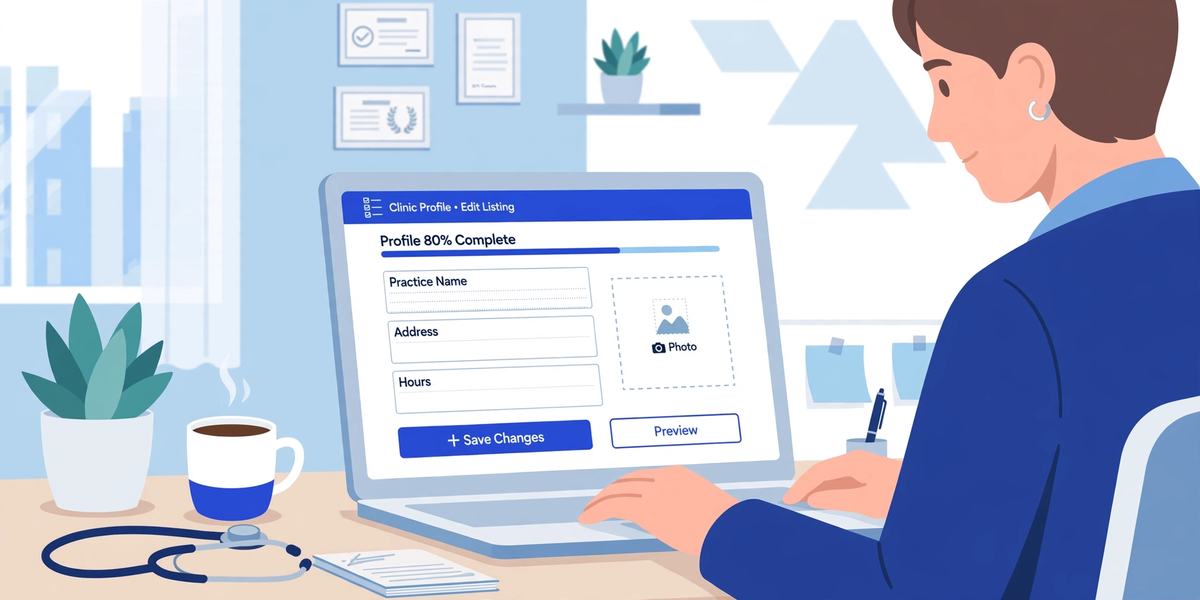
The fix is unglamorous and mostly free. Check what your listing says. If it is wrong or bare, complete it: your website address, the services you actually offer, and a short description written the way you would explain the practice to a new patient. On this directory you can add your business or send a correction, and our page about the directory data explains where listings come from and how checking works. The same habit is worth applying anywhere your practice is listed.
The other half sits on your own site. A listing can only point to a website that exists and says something useful. A practice website that names its services, its clinicians and its booking route gives every directory, search engine and assistant a source to cite. Our healthcare website services page sets out what we build for clinics that need one, and there is no obligation attached to reading it.
The Limits of This Data
Three limits matter. First, this is registry and directory data. Registry records can lag behind real life when a practice moves, renames or changes its phone number, and a listing is a snapshot, not a live feed. Second, the directory covers 14 specialties chosen by Med Clinic X. It is not a census of US healthcare, and its shape reflects those choices as well as the registry underneath it. Third, nothing here measures patients. We counted listings, not searches, calls or appointments, and no figure in this article should be read as evidence about demand in any town or specialty.
How We Counted
On 11 November 2026 we counted the directory's published data files directly: the core listing set the site holds in its code, 13,049 listings, and the 14 specialty data files the site serves, 310,348 listings. No listing appeared in both sets, and the combined total, 323,397, matched the total the live directory itself reported on the same day. A listing counts as carrying a website when its website field holds an address. The checked set is the group whose source is recorded as the practice's official website. Description length is a word count of the description field, and state and specialty are the values each listing carries. The counting script and the full figures table are kept with our programme records, so the count can be run again and checked.
Percentages in this article are shares of the full 323,397 listings unless a paragraph says otherwise, rounded to one decimal place. State counts use the state value each listing carries, which is how the territories and a small number of military post codes come to appear alongside the 50 states. Nothing was sampled, nothing was estimated and nothing was rounded up to make a point. Where a figure could not be counted cleanly from the data files, we left it out rather than approximating it.
We will repeat this count as the checking work grows, and the interesting number to watch is the checked share: 2.0 percent today. If you run a practice and want to see the directory for yourself, browse the directory, try the live demo of the software behind it, or ask for a quote if a website or a patient portal is on your list for this year.

Written by Chloe Vance
Healthcare Marketing DirectorChloe Vance has led search engine optimization and digital patient acquisition strategies for top pediatric, dental, and multi-specialty clinical chains.
Frequently Asked Questions
Common conversational queries evaluated by our natural language models concerning deployment guidelines.