
Key Takeaways
- ✓A stress test shows how your heart copes with exertion, usually by walking on a treadmill while your heart rate and blood pressure are watched.
- ✓There are several types of stress test, including exercise, medicine-based and imaging versions, and your doctor chooses the one that fits your health.
- ✓Wear comfortable clothes and walking shoes, avoid caffeine on the day, and ask the clinic which medicines to take or skip.
- ✓A normal result is reassuring but not the whole picture, and an abnormal result usually leads to more detailed testing.
- ✓Ask when you will hear back about the results and what happens next, so you leave with a plan.
A stress test sounds harder than it is. For most people it means walking on a treadmill while a clinician watches your heart rate, blood pressure and heart tracing. The point is simple: to see how your heart copes when it has to work harder. This guide explains the types of stress test, why one is ordered, how to prepare, what happens on the day, and what the results mean.
What a Stress Test Is
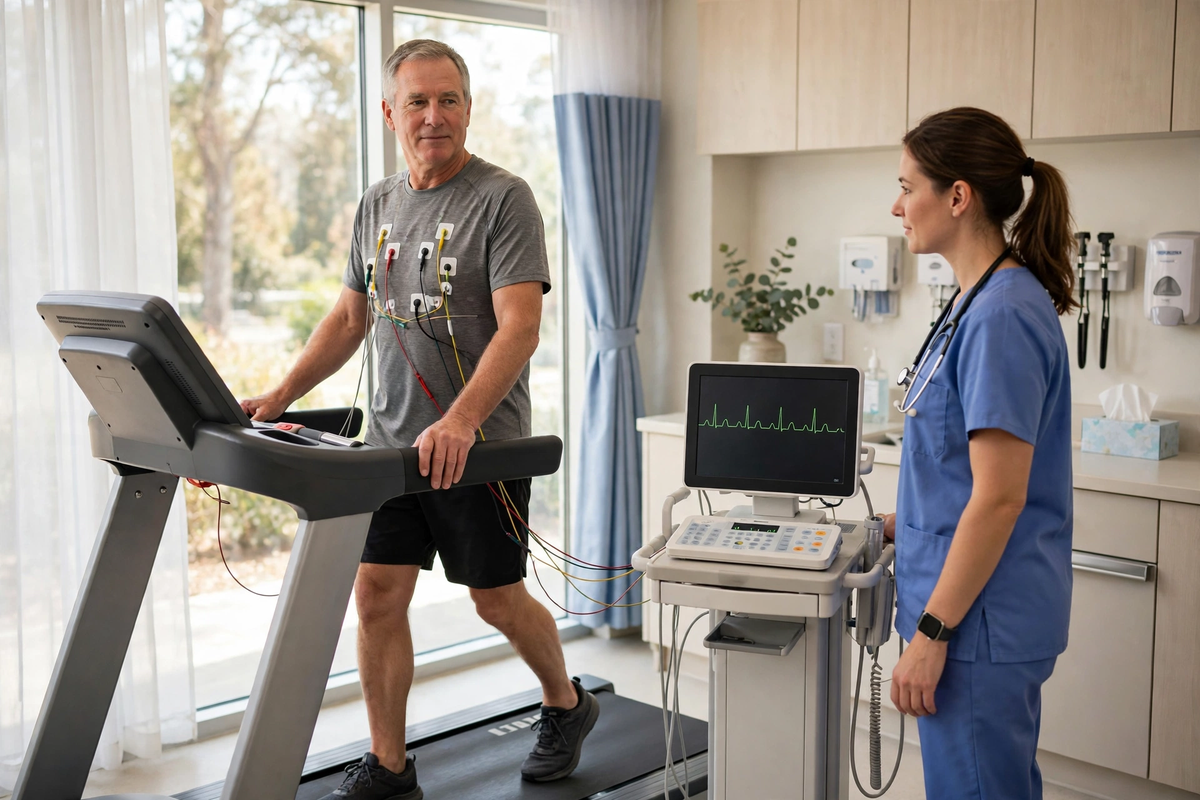
A stress test, also called an exercise stress test, records how your heart behaves while you exercise. Electrodes are placed on your chest to record the heart tracing, a blood pressure cuff measures your pressure at intervals, and you walk on a treadmill that slowly gets faster and steeper. The test usually lasts about 30 to 60 minutes from start to finish, including preparation and a short rest afterwards, though the walking part is often only around 10 minutes.
The test shows things a resting heart tracing cannot. Some heart problems only appear when the heart is working hard, such as reduced blood flow to part of the heart muscle. By watching the heart under strain, the doctor can judge whether chest pain or breathlessness is likely to come from the heart, and whether further tests are needed. It is a common test, and clinics run it every day.
Types of Stress Tests
The exercise test on a treadmill is the most common form, but it is not the only one. If you cannot walk far enough, or if a joint problem or breathing problem makes exercise hard, the doctor may use medicine instead. The medicine makes the heart work harder in a similar way, while you lie still. Imaging can also be added, so the doctor can see how the heart muscle moves and how blood flows through it.
| Type | How it works | Who it suits |
|---|---|---|
| Exercise stress test | You walk on a treadmill while your heart is watched | Most people who can walk and exercise safely |
| Medicine stress test | Medicine makes the heart work harder while you lie still | People who cannot walk far or exercise |
| Stress test with imaging | An ultrasound or scan is added to the exercise or medicine test | When the doctor needs a clearer picture of blood flow |
| Nuclear stress test | A small amount of tracer is used with a scan to show blood flow | When other tests leave the picture unclear |
Your doctor chooses the type based on your health, your medicines and what the test needs to answer. You do not need to choose between them yourself. Ask which type you are booked for when the clinic calls, so you know what to expect and how to prepare.
Why Your Doctor Orders One
A stress test is usually ordered when symptoms point to the heart but a resting test has not given a clear answer. Chest pain or pressure during activity, breathlessness that comes on with exertion, or a heart tracing that looks borderline at rest are common reasons. It is also used to check how well treatment is working after a heart procedure, or to judge whether it is safe to start a new exercise programme.
The test is also a planning tool. If the result is normal, the doctor may look elsewhere for the cause of your symptoms. If it shows reduced blood flow, the next step is often a more detailed scan or a look at the heart arteries. Either way, the result helps the doctor and you decide what happens next, rather than leaving the question open. Our guide on how to choose a cardiologist explains how to find a heart specialist if your results point that way.
How to Prepare
Preparation is mostly about clothes, food and medicines, and the clinic will give you exact instructions when you book. Wear comfortable clothes and walking shoes, since you will be on a treadmill. Do not eat a heavy meal in the hours before the test, and avoid coffee and other caffeinated drinks, since caffeine can affect the result. Bring a list of your medicines, and ask the clinic which ones to take on the day.
- Wear comfortable clothes and flat walking shoes
- Avoid coffee, tea, energy drinks and chocolate on the day
- Do not eat a heavy meal in the hours before the test
- Bring a list of all medicines and supplements you take
- Ask the clinic which medicines to take or skip on the day
- Bring your insurance card, a photo ID and a water bottle
- Tell the clinic if you have asthma, a joint problem or trouble walking
Some medicines are paused before the test, since they slow the heart and would hide the effect the doctor wants to see. Never stop a prescribed medicine without asking the clinic first. The clinic will tell you exactly which medicines to skip and for how long, and what to do if you take insulin or other medicines that need food. If you use an inhaler, bring it with you, and tell the team about any breathing problems before the test starts.
What Happens on the Day
When you arrive, the team will explain the test and answer your questions. Electrodes are stuck to your chest to record the heart tracing, and a blood pressure cuff is fitted to your arm. You will walk on the treadmill, which starts slowly and then gets faster and steeper in stages. The team watches your heart tracing, blood pressure and symptoms throughout, and asks how you feel at each stage.
| Stage | What happens | How long |
|---|---|---|
| Preparation | Electrodes fitted, blood pressure checked, questions answered | About 15 minutes |
| Exercise | Walking on the treadmill, getting faster and steeper | Often around 10 minutes |
| Recovery | You sit or walk slowly while the team watches your heart settle | About 10 to 15 minutes |
| Results | The doctor reviews the tracing and talks through the findings | At the visit or a few days later |
The test stops when you reach the target heart rate, when you feel too tired or breathless to continue, or when the team sees a change they want to check. You can ask to stop at any time, and the team would rather you say so than push through discomfort. After the test you will sit and rest while your heart rate and blood pressure return to normal, and the team will check that you feel well before you leave. Our guide on preparing for a blood test covers another common test day, if you have blood work booked as well.
What the Results Mean
The doctor reads the heart tracing, your blood pressure response and your symptoms together. A normal result means the heart coped well with exertion and no clear sign of reduced blood flow appeared. That is reassuring, but it does not rule out every heart problem, so the doctor will weigh it against your history and other tests. An abnormal result means something changed during exercise that needs a closer look, and the next step is usually a more detailed scan or a look at the heart arteries.
One result is not the whole story
A stress test result is one piece of the picture. Your doctor reads it together with your symptoms, your history and your other test results, and repeats or extends testing when the picture is unclear. Ask what the result means for you and what happens next, so you leave with a plan, not just a report.
Results are sometimes ready on the same day, and sometimes take a few days if imaging needs a specialist to read it. Ask when you will hear back, and how the clinic will reach you. If you have not heard by the date they gave, call the clinic rather than waiting. Our guide on understanding your lab test results explains how to read a report and what the common terms mean.
Risks and When to Call
A stress test is generally safe, and clinics run it every day with trained staff and equipment on hand. The most common effects are tiredness, breathlessness and a sore chest or legs from the exercise, and these usually settle quickly once you rest. Some people feel dizzy or sick during the test, and the team will stop it and help you recover. Serious problems are rare, and the team is trained to act fast if they appear.
After the test, call the clinic at once if you have chest pain or pressure that does not settle, severe breathlessness, fainting, or a fast or irregular heartbeat that does not slow down. These are not common, but they need prompt medical care, so do not wait for your follow-up visit. If you were given medicine to stress the heart, tell the team about any effects that linger after you go home.
Insurance and Costs in General Terms
A stress test is usually covered when a doctor orders it for a medical reason, such as chest pain or breathlessness during activity, but the details vary by plan. The test itself, the imaging and the doctor reading the results may each be billed separately, so ask the clinic for an estimate before you book, and ask whether prior authorization is needed.
Check the network before you book. An out-of-network clinic or imaging center can cost much more, and some plans will not pay at all. If you have a high deductible plan, ask what you will owe for the test and the reading, and whether the clinic offers a payment plan. Our guide on understanding your health insurance plan explains deductibles, copays and networks in plain terms, and it can help you read your own plan before you call.
Questions Worth Asking
A short list of questions helps you leave with a clear plan. Ask them when you book and again on the day, and write down the answers so you can look back at them later.
- Which type of stress test am I booked for, and why that type?
- Which medicines should I take or skip on the day?
- What should I eat and drink before the test?
- How long will the test take, and will someone need to drive me home?
- When will I get the results, and how will the clinic reach me?
- What happens next if the result is abnormal?
It also helps to ask about medicines you already take. Blood pressure medicines, heart medicines and inhalers can all affect the test, and the team can explain which ones fit your situation. If a new medicine is prescribed after the test, ask how to take it, what side effects to watch for, and when to call the clinic. Our guide on understanding your prescription covers dosages, refills and questions worth asking at the pharmacy.
A stress test is a routine way to learn how your heart copes with exertion, and most people find it simpler than they expected. Prepare as the clinic asks, wear comfortable shoes, and tell the team how you feel during the test. Bring your questions, and make sure you leave knowing what the result means and what happens next. If your clinic wants an easier way to handle bookings, reminders and patient messages, you can request a quote from Med Clinic X and see what fits your practice.

Written by Chloe Vance
Healthcare Marketing DirectorChloe Vance has led search engine optimization and digital patient acquisition strategies for top pediatric, dental, and multi-specialty clinical chains.
Frequently Asked Questions
Common conversational queries evaluated by our natural language models concerning deployment guidelines.