
Key Takeaways
- ✓A sleep study records breathing, oxygen, heart rate and sleep patterns overnight, and it is painless.
- ✓An in-lab study records more detail, while a home study is simpler and takes place in your own bed.
- ✓Keep your normal routine in the days before, avoid naps and caffeine late in the day, and check your medicines with the clinic.
- ✓Bring comfortable sleep clothes, toiletries, your medicines, and something quiet to read before bed.
- ✓Results take a few days to a week or more, and your doctor will explain what they mean and what happens next.
A sleep study is an overnight test that records what happens while you sleep. Small sensors track your breathing, your oxygen level, your heart rate and your sleep patterns through the night. The test is painless, and most people sleep for at least part of the night even when the room is new to them. This guide explains what happens before, during and after the study, so you can arrive ready and rest well.
It covers why a sleep study is ordered, the difference between an in-lab study and a home study, booking and insurance in general terms, how to prepare, what to bring, the evening at the lab, the sensors, the morning after, and how results work. If you do not have a regular doctor yet, our guide on how to find a primary care doctor explains how to choose one, since that doctor is often the one who orders the test.
A doctor orders a sleep study when sleep may be behind a health problem. Loud snoring, pauses in breathing during sleep, waking up gasping, daytime sleepiness, morning headaches, or trouble staying asleep can all point to a sleep problem. A study can also help when a treatment is not working as hoped, or when a doctor wants to check how well a sleep treatment is working.
The most common reason is a check for sleep apnea, where breathing pauses or becomes shallow during sleep. A study can also look at other sleep problems, such as restless legs, unusual movements, or waking often during the night. The result gives the doctor a clear record of the night, rather than a guess based on symptoms alone.
A sleep study is often ordered alongside other checks. A doctor may look at your general health, your medicines, and your sleep habits first, and may order a blood test or another check to rule out other causes of tiredness. If your doctor orders a blood test as well, our guide on preparing for a blood test explains fasting and what happens on the day.
There are two main kinds of sleep study. An in-lab study takes place overnight in a sleep lab, in a private room with a bed, and a technologist watches the recording from another room. A home study uses a small portable device that you wear in your own bed, and you return it the next day. Your doctor will choose the kind that fits your symptoms and your health history.
| Study type | Where it happens | What it records |
|---|---|---|
| In-lab study | A sleep lab, in a private room | Brain waves, breathing, oxygen, heart rate, leg movement, and snoring |
| Home study | Your own bed, at home | Breathing, oxygen, heart rate, and snoring, with fewer sensors |
An in-lab study records more detail, so it is often used when the problem is unclear, when more than one sleep problem may be present, or when a home study did not give a clear answer. A home study is simpler and suits many people with clear signs of sleep apnea. It is also a good choice when a lab stay is hard to arrange. If a home study result is unclear, your doctor may still suggest an in-lab study afterwards.
Your doctor will send a referral to the sleep clinic, and the clinic will call you to book a date. Ask how long the evening will last, what time to arrive, and what time you can leave in the morning. If you need a morning appointment for work, or a room that suits a mobility need, say so when you book, since the clinic can often plan around it.
Check your insurance cover before the night. Ask the clinic what the study costs under your plan, whether a referral or prior approval is needed, and whether any part of the cost falls to you. Keep the name of the person you spoke to and the date of the call, in case you need to check it later. If you are unsure whether to seek another view, our guide on getting a second opinion explains how to do that in a calm and simple way.
Keep your normal routine in the days before the study. Go to bed and wake up at your usual times, and try not to change your sleep pattern for the test. A very early night or a late night before the study can make it harder to fall asleep in the lab, so a normal day is the best preparation. Eat as normal, and drink water as usual through the day.
Avoid naps on the day of the study, since a nap can make it harder to fall asleep at night. Avoid caffeine after midday, and avoid alcohol on the day of the study, since both can change how you sleep and how you breathe. Ask the clinic about sleep medicines, since some may need to be paused or taken as normal, and never stop a medicine on your own.
- Keep your usual bedtime and wake time in the days before the study
- Avoid naps on the day of the study, so you feel sleepy at bedtime
- Avoid caffeine after midday and alcohol on the day of the study
- Wash your hair on the day of the study, and avoid hair gel, oils and heavy creams
- Shave if you use a chin sensor area, and trim any thick facial hair that may lift a sensor
- Check your medicines with the clinic, and bring a list of everything you take
Wash your hair on the day of the study, since clean hair helps the small sensors stick. Avoid hair gel, oils and heavy face creams, since they can loosen the pads. Wear comfortable clothes for the drive to the lab, and bring your sleep clothes with you. If you use a breathing machine at home, ask the clinic whether to bring it, since the team may want to check its settings.
Pack as you would for a quiet night away from home. You will have a private room with a bed, a bathroom, and a call button for the team. Bring the items below, and leave valuables at home where you can, since the room is yours for the night but you will want to travel light in the morning.
- Comfortable sleep clothes, such as a loose top and shorts or pyjamas
- Toiletries for the evening and the morning, including a toothbrush
- Your medicines for the night and the morning, in their original boxes
- Your ID, your insurance card, and your appointment letter
- Something quiet to read, or a book, for the time before bed
- Earplugs if light noise bothers you, and your own pillow if you prefer it
You can bring a phone or a tablet, but keep it for reading or quiet use only, and put it away at bedtime. Bright screens late at night can make it harder to fall asleep. If you wear contact lenses, bring your case and solution, and bring glasses if you use them. Tell the clinic in advance if you need help with stairs, or if you use a mobility aid.
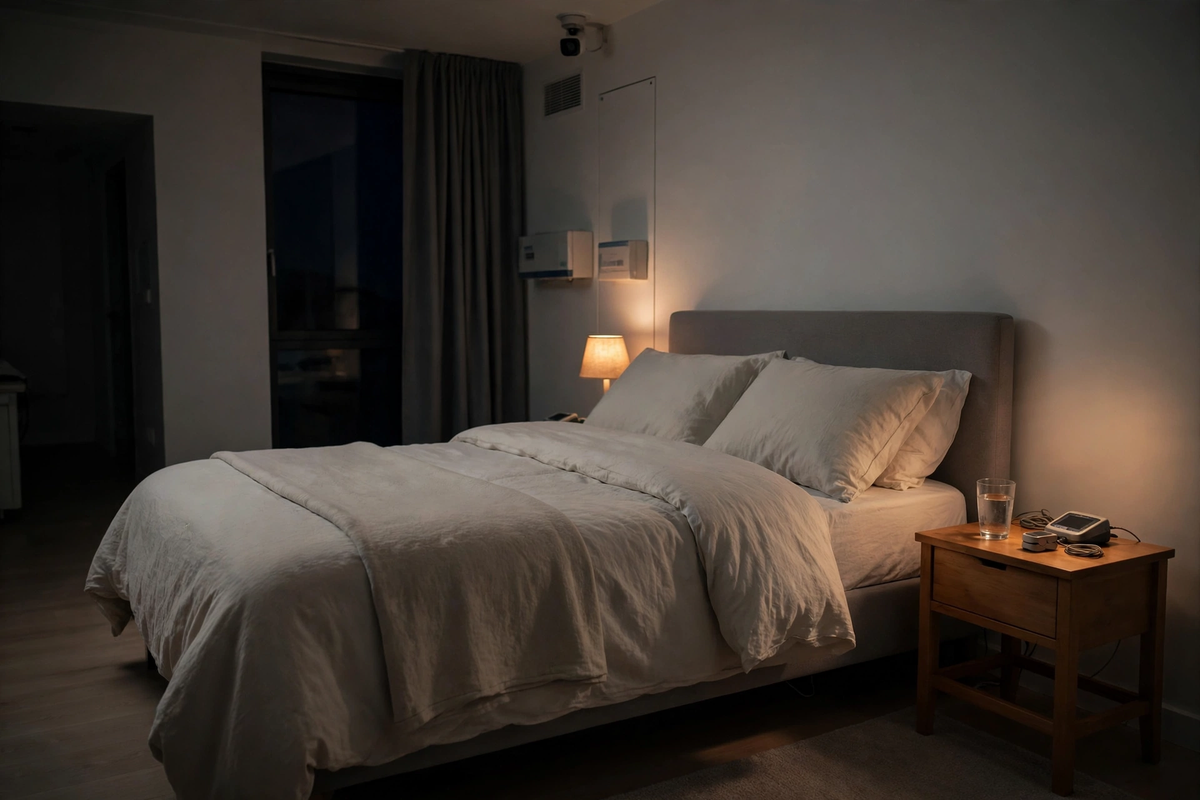
Arrive at the time on your appointment letter, usually in the early evening. You will check in, and the team will confirm your name, date of birth, and the reason for the study. A technologist will show you to your room, explain the evening, and answer your questions. The room is set up like a small hotel room, with a bed, a chair, a television, and a private bathroom.
You will change into your sleep clothes and settle in for the evening. The technologist will fit the sensors, which takes about half an hour, and will test each one to make sure it is working. You can read, watch television, or relax until your usual bedtime. When you are ready for sleep, press the call button or tell the team, and they will dim the lights and start the recording.
The sensors are small and painless. Sticky pads on your head record brain waves, so the team can tell when you are awake, in light sleep, or in deep sleep. A soft clip on your finger measures your oxygen level, and belts around your chest and stomach track how you breathe. Small pads on your legs record movement, and a sensor near your nose and mouth records airflow.
A microphone may record snoring, and a camera may record movement during the night, so the team can see what happened if a sensor reading is unclear. The recording is watched from another room, and the technologist can speak to you through a speaker if a sensor comes loose. Nothing in the room will hurt you, and you can move in bed as normal.
Most people notice the sensors at first and then forget them as they settle. The wires are light and long enough to let you turn over in bed, and you can sleep on your side or your back as usual. If a sensor feels tight, itchy, or loose, press the call button and the team will come and adjust it. Do not try to fix a sensor yourself, since the team can do it quickly without waking you fully.
If you need the bathroom during the night, press the call button first, so the team can unplug you from the recording box. They will help you up and plug you back in when you return. It is normal to wake once or twice in a new place, and a short wake does not spoil the study. The team needs a good sample of sleep, not a perfect night.
A good night starts before bedtime
Keep your normal bedtime if you can. A very early night can make it harder to fall asleep in a new room, and a late night can leave you too tired to settle. Aim for your usual routine.
The team will wake you at the time agreed the night before, usually in the early morning. They will remove the sensors, which takes only a few minutes, and the sticky pads come off with warm water. You can wash, change into your day clothes, and have breakfast if the clinic offers it. Most people leave within an hour of waking.
You can drive home as normal, unless you took a sleep medicine the night before and still feel drowsy. If you feel sleepy in the morning, take your time, drink some water, and rest before you drive. Ask the team before you leave whether the recording worked well, and when you should expect to hear about the result.
A sleep doctor reads the full recording first, which takes time. A home study result is often ready within a few days, while an in-lab study can take a week or more. The clinic should tell you when to expect the result and how it will reach you, by phone, portal message, or at a follow-up visit. Our guide on understanding your lab test results explains how to read a report in plain language when it arrives.
The result may show normal sleep, mild sleep apnea, or a clearer sleep problem that needs treatment. Your doctor will explain what the result means for you, and what happens next, which may be a change in sleep habits, a breathing machine, a mouth device, or a follow-up study. If you would like copies of the report, our guide on how to get your medical records explains how to ask for them.
A short list of questions helps you leave with a clear plan. Ask them when the study is booked, or when you arrive at the lab.
- Is my study in the lab or at home, and why was that kind chosen?
- Should I take my usual medicines, including sleep medicines, as normal?
- What time should I arrive, and what time can I leave in the morning?
- What will the study record, and will a camera be used during the night?
- When will I hear the result, and who will explain it to me?
- What happens if the result shows sleep apnea or another sleep problem?
A sleep study takes one night, and the hardest part is usually the worry before it. Keep your normal routine, pack light, arrive on time, and tell the team if anything feels uncomfortable during the night. If you would like help finding a practice near you, get a quote from Med Clinic X and we can point you in the right direction.

Written by Chloe Vance
Healthcare Marketing DirectorChloe Vance has led search engine optimization and digital patient acquisition strategies for top pediatric, dental, and multi-specialty clinical chains.
Frequently Asked Questions
Common conversational queries evaluated by our natural language models concerning deployment guidelines.