
Key Takeaways
- ✓A bone density scan, often called a DEXA scan, is a quick and painless test that measures how strong your bones are.
- ✓No fasting is needed, but your clinic may ask you to skip calcium supplements for a day before the scan.
- ✓Wear loose clothing without metal zips, buttons or buckles, and leave jewellery at home.
- ✓The scan usually takes 10 to 30 minutes, and you lie still on a padded table while the scanner passes over you.
- ✓A T-score compares your bones with a healthy young adult, and it is the score doctors use to diagnose low bone density or osteoporosis.
A bone density scan sounds more serious than it is. It is a quick, painless test that measures how strong your bones are, and it usually takes less time than a routine check-up. If your doctor has ordered one, this guide explains why, how to prepare, what happens on the day, and what the results mean.
What a Bone Density Scan Is
A bone density scan measures the mineral content of your bones, usually at the hip and the lower spine, and sometimes at the forearm. The test most often used is called a DEXA scan, short for dual-energy X-ray absorptiometry. It uses a very small amount of radiation, much less than most other imaging tests, to build a picture of your bones and work out how dense they are.
The result is given as a score, not a picture you need to read yourself. The main score is called a T-score, and it compares your bone density with that of a healthy young adult. A T-score of -1.0 or above is considered normal. A score between -1.0 and -2.5 means low bone density, and a score of -2.5 or below points to osteoporosis. Your doctor will explain what your score means for you, and what should happen next.
Why Your Doctor Orders One
Bone loss has no symptoms until a bone breaks, so the scan is a way to catch it early. Your doctor may order one if you have broken a bone from a minor fall, if you have lost height over time, or if you have a stooped posture. It is also ordered for people with a higher risk of weak bones, such as women after menopause, men over 70, people who take steroid medicines for a long time, and people with certain conditions that affect the bones.
A scan is also used to track change. If you have already been told you have low bone density, a repeat scan shows whether treatment is working or whether bone loss is continuing. The first scan sets the baseline, and later scans are compared with it, so the same areas are measured each time. If you have been referred by your primary care doctor, our guide on how to find a primary care doctor explains how that first step works.
Booking and Insurance
A bone density scan is usually done at a hospital imaging department or a standalone imaging center, and it needs an appointment. When you book, the clinic will ask about metal implants, recent scans with contrast dye, and whether you might be pregnant, since these can affect the scan or the reading. Tell them about any implants, screws or plates, so the technologist can plan which areas to measure.
Most insurance plans cover a bone density scan when a doctor orders it for a medical reason, such as a fracture, long-term steroid use, or age and risk factors. Some plans cover a first screening scan at a certain age, and some need prior authorisation before they will pay. Ask the imaging center to check your coverage when you book, and ask what you will owe. Our guide on understanding your health insurance plan explains deductibles, copays and networks in plain terms.
Preparing in the Days Before
There is little to do before a bone density scan, and that is part of what makes it easy. You do not need to fast, and you can take your usual medicines unless the clinic tells you otherwise. The main request is usually about calcium. Calcium supplements can show up on the scan and affect the reading, so the clinic may ask you to skip them for a day before the test. Check when you book, since advice varies by clinic.
Tell the clinic if you have had a recent scan that used contrast dye, or a nuclear medicine test, since the dye can linger and affect the result. The clinic may ask you to wait a few days between tests. If you think you might be pregnant, say so when you book, since the scan uses a small amount of radiation and the doctor will want to weigh the need for the test.
- Skip calcium supplements for a day before the scan, if the clinic asks
- Tell the clinic about metal implants, screws, plates or a hip replacement
- Mention any recent scan that used contrast dye
- Say so if you might be pregnant
- Keep taking your usual medicines unless the clinic tells you otherwise
- Bring your insurance card, a photo ID and the referral from your doctor
What to Wear and Bring
Wear loose, comfortable clothing with no metal in it. Zips, buttons, buckles and underwire bras can show up on the scan, so choose clothes without them, or be ready to change into a gown. Leave jewellery, watches and belts at home, or be ready to take them off before the scan. You will stay in your own clothes for most of the visit if they are metal-free.
Bring your insurance card, a photo ID and the referral or order from your doctor. If you have had a bone density scan before, bring the earlier report if you have it, since the new result is compared with the old one. Our guide on how to get your medical records explains how to request past reports from another clinic.
The one thing to remember
Lie still, breathe normally, and let the machine do the work. The scan is painless, and the hardest part is holding one position for a few minutes at a time.
Arriving at the Imaging Center
Arrive a few minutes early so you can check in and complete any forms without rushing. The receptionist will confirm your details and your insurance, and the technologist will talk through the scan before it starts. This is a good time to mention anything you forgot when you booked, such as a recent fall, a new medicine, or a metal implant.
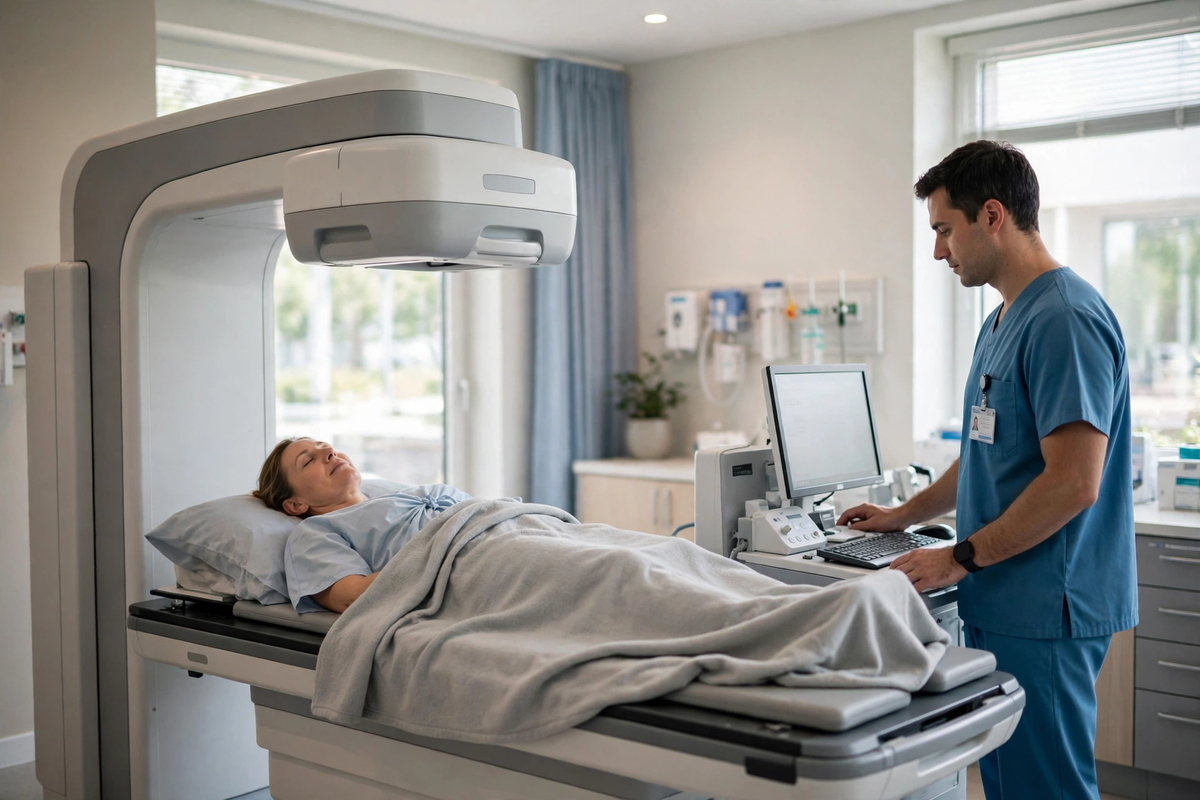
You will be shown to a private room with the scanner. The room is quiet and the table is padded. The technologist will ask you to lie on your back, and may place a support under your knees or ask you to rest your legs on a raised block. This position lines up the hip and spine so the scanner can measure them clearly.
During the Scan
The scan itself is simple. You lie still on the table while a scanner arm passes slowly over your body, usually over the lower spine first and then the hip. Nothing touches you except the table, and the machine makes no loud noise. You need to hold still while each part is measured, which takes a few minutes per area, and you can breathe normally throughout.
| Step | What happens | How long |
|---|---|---|
| Check-in and forms | Confirm your details, insurance and referral | About 10 minutes |
| Changing | Change into a gown if your clothes have metal | A few minutes |
| Spine measurement | Lie on your back while the scanner passes over your lower spine | About 5 minutes |
| Hip measurement | Your leg is turned slightly inward while the hip is measured | About 5 minutes |
| Results discussion | The technologist explains what happens next, and the report goes to your doctor | A few minutes |
The whole visit usually takes 10 to 30 minutes, including check-in. If the technologist needs a clearer image, a measurement may be repeated, which adds only a few minutes. You can drive yourself home afterwards, and you can go back to your normal routine straight away.
Results and What the Numbers Mean
Your results are not given on the spot. The images are read by a radiologist, and a report goes to the doctor who ordered the scan, usually within a few days. Your doctor will then talk through the results with you, either at a follow-up visit or by phone, and explain what they mean for your care.
The report centers on the T-score. A score of -1.0 or above is normal. A score between -1.0 and -2.5 means low bone density, sometimes called osteopenia. A score of -2.5 or below points to osteoporosis, which means the bones are weaker and more likely to break. The report may also include a Z-score, which compares your bone density with people of your own age, sex and size, and helps the doctor judge whether your bone loss is more than expected for your age.
A single number does not tell the whole story. Your doctor will read the score together with your age, your history of fractures, the medicines you take, and your family history, and then decide whether treatment, a change in diet or exercise, or simply a repeat scan in a year or two is the right next step. Our guide on understanding your lab test results explains how to read a report and what to ask when the numbers are unclear.
After the Scan and Next Steps
There is nothing to recover from, and no aftercare is needed. You can eat, drive and return to your normal day as soon as you leave. The only thing to do is to make sure you hear back about the results. If a week has passed and you have not heard anything, call the clinic or your doctor's office and ask for the report.
If the scan shows low bone density, your doctor may suggest changes to diet, exercise and daily habits, and may talk about medicines that slow bone loss. Endocrinologists often manage osteoporosis care, and our guide on how to choose an endocrinologist explains what that specialist does and how to find one. A follow-up scan is usually booked for a year or two later, so the change can be tracked over time.
Questions Worth Asking
A short list of questions helps you leave with a clear plan. Ask them when the scan is booked, or when you talk through the results with your doctor.
- Why am I having this scan, and which areas will be measured?
- Do I need to stop calcium supplements or any medicine before the scan?
- When will the results be ready, and how will I hear about them?
- What does my T-score mean, and what is my Z-score?
- Do I need treatment, or is a repeat scan in a year or two enough?
- What can I do now to keep my bones strong?
A bone density scan takes less than half an hour, and it gives you and your doctor a clear starting point for keeping your bones strong. Prepare simply, wear clothes without metal, and ask for the results if you have not heard back within a week. It is a small step that can prevent a much bigger problem later. If your clinic wants an easier way to handle referrals, bookings and patient messages, you can request a quote from Med Clinic X and see what fits your practice.

Written by Chloe Vance
Healthcare Marketing DirectorChloe Vance has led search engine optimization and digital patient acquisition strategies for top pediatric, dental, and multi-specialty clinical chains.
Frequently Asked Questions
Common conversational queries evaluated by our natural language models concerning deployment guidelines.