Key Takeaways
- ✓Every location competes in its own local market: it needs its own page, its own Google Business Profile, its own reviews and its own accurate details.
- ✓Write location pages from what is genuinely different about each site. Shared structure is fine, cloned sentences are discounted by search engines and distrusted by patients.
- ✓Keep one master record per location and reconcile the page, profile and directories against it. Any change updates all of them together, with one named owner.
- ✓Handle reviews location by location: ask evenly, respond briefly without confirming anyone is a patient, and route recurring themes back into operations and page content.
- ✓Measure each location separately, a healthy group average hides failing sites, and fix in order: data accuracy, weakest pages, review flow, then listings.
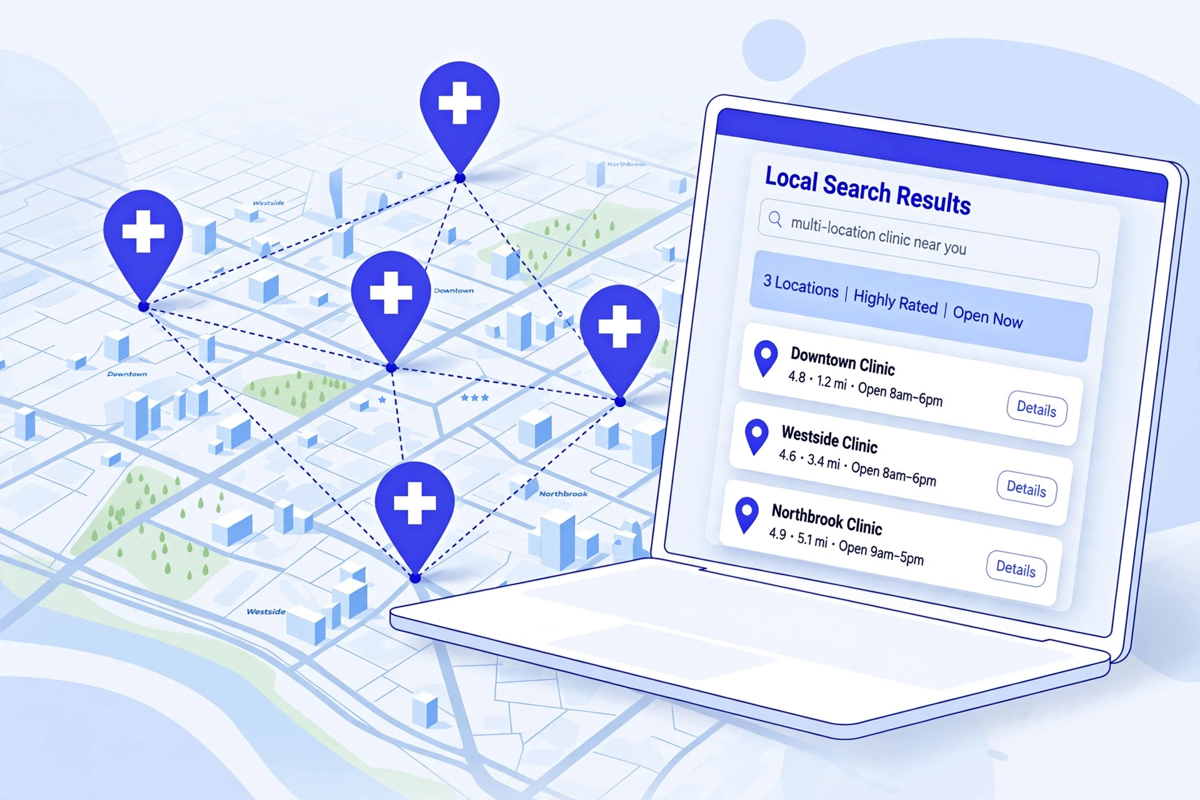
A clinic group with three, ten or fifty locations does not have one local search presence. It has one per location, competing in a different map, against different neighbours, for patients who will only travel so far. Treating the whole group as a single website with a single location page is the most common reason multi-location practices underperform in local search: the flagship location ranks, the newer sites stay invisible, and head office cannot tell which location needs help because reporting blends everything into one average.
This guide shows how to structure multi-location SEO properly: one strong location page per site, one complete Google Business Profile per location, consistent listings data, reviews handled location by location, and reporting that shows each site on its own merits. It builds on the SEO for doctors guide, which covers the foundations for a single practice, and the Google Business Profile for clinics guide, which goes deeper on profile setup. Here the focus is what changes when you run more than one location, and how to keep quality high as the group grows.
Why Multi-Location SEO Is a Different Problem
Patients search locally even when they love your brand. Their queries combine a service with a place, a neighbourhood, a suburb, a town, or they search on a map and choose from what is near them right now. Search engines answer those queries location by location, so a patient three miles from your second site will never see your flagship page if a competitor closer to them has a clearer local presence. Each location therefore needs its own proof: its own page, its own profile, its own reviews and its own accurate details, all of which must agree with each other.
Scale creates the second problem: consistency at volume. With one location, keeping hours, phone numbers and services accurate is a chore. With ten, it is a system problem, one location changes its Saturday hours, a phone number is replaced during a refit, a clinician moves sites, and unless someone owns the update everywhere it appears, your listings quietly contradict each other and patients arrive at a closed door or call a dead number. Multi-location SEO is therefore as much an operations discipline as a marketing one, and this guide treats it that way.
- Every location competes in its own local market, against its own set of nearby rivals.
- Every location needs its own page, profile, reviews and contact details, not a mention on a group page.
- Data accuracy is a system, not a task: one change must flow to the website, profiles and directories together.
- Blended group reporting hides failing locations. Measure and fix site by site.
One Strong Location Page Per Site
Each location deserves a real page, written for the patients who might actually visit it. That page should carry the location's full name, address and local phone number, its opening hours, parking and public transport details, the services genuinely offered at that site, the clinicians who actually work there, and clear booking routes, online booking for that location, not the group's generic number. Photographs of the real building, entrance and team help patients recognise the place on arrival and help the page feel like a specific clinic rather than a template.
The trap to avoid is cloning. Copying one location page and swapping the town name produces thin, near-duplicate pages that search engines discount and patients find faintly untrustworthy. The page says nothing true about that place that it does not also say about everywhere else. Write each page around what is genuinely different: the neighbourhood it serves, the services that are only offered there, the clinicians based there, the journey patients take to reach it, and the questions that location's front desk actually gets asked. Shared structure is fine. Shared sentences are not.
| Element | What belongs on the location page | Common mistake |
|---|---|---|
| Identity | Location name, full address, local phone number, map and directions | Group head-office address and a central call-centre number only |
| Hours and access | That site's real hours, parking, entrances, accessibility and transport notes | Group-wide hours copied to a site that closes earlier |
| Services | Only the services actually delivered at that location, linked to service pages | The full group service list pasted onto every location page |
| People | Clinicians based at that site, with links to their profile pages | The whole group's clinician list on every page |
| Local proof | Photos of the real site and location-specific patient information | Stock photos and a paragraph with only the town name changed |
| Booking | A booking route that lands the patient at that location | A generic contact form that loses which site the patient wanted |
Give each location page a clean, stable web address that includes the place, the pattern your healthcare website already uses for service pages works just as well here, and never change those addresses casually. Location pages accumulate links, bookmarks and directory references over time, and every unnecessary change spends that accumulated value. When a location genuinely moves or closes, use permanent redirects and update every listing. Do not simply delete the page and leave patients and search engines at a dead end.
One Google Business Profile Per Location
Each physical location that sees patients needs its own Google Business Profile, verified for that address, with that location's real name, category, hours, phone number and website link pointing at its location page, not the homepage. The profile and the page are a pair: the profile wins the map visibility, the page gives the patient the detail and the booking route, and each strengthens the other when the information agrees exactly. Groups should manage profiles centrally so branding, categories and service lists stay consistent, while locations feed in their genuine local updates, hour changes, new clinicians, temporary closures.
Resist the shortcuts that create long-term damage. A single profile listing several addresses, duplicate profiles for the same site created to chase rankings, or profiles at addresses where patients are never seen all invite suspension, confusion or both, and unpicking merged or suspended profiles costs far more time than setting them up correctly. When you open a new location, create and verify its profile as part of the opening checklist, alongside signage and phone lines. Local visibility on opening day is worth real bookings, and verification takes time you cannot recover later.
Name locations honestly
Use the real-world name of each location as patients see it on signage and documents. Adding keywords, services or slogans into a business name to chase rankings breaches platform guidelines and risks suspension, and it confuses patients comparing your profile with your building. Earn visibility with complete profiles, accurate data, strong pages and genuine reviews, the things this guide covers, not with a renamed listing.
Keep a simple master record for every location: address exactly as it should appear everywhere, phone number, hours, profile link, page address and the date each was last checked. That sheet is the source of truth your website, profiles and directories are reconciled against, and it turns every future change, a refit, an hours change, a new site, into a short checklist instead of a research project. Assign one owner for the master record, even if updates are made by several people.
Listings, Directories and Data Consistency
Beyond your own site and profiles, each location appears across directories, insurer listings, mapping services and your own healthcare directory presence. Patients cross-check these sources, and inconsistencies, an old address in one place, a different phone number in another, cost bookings in two ways: patients hesitate when details disagree, and search engines trust a location less when its data conflicts across the web. Work location by location through the major listings, correct each one against your master record, and note where each listing lives so the next correction is faster.
Prioritise by consequence rather than trying to fix everything at once. The profile, your own location page, the main map and search listings, and the directories patients in your area actually use come first. Obscure directories that nobody reads can wait, and some are not worth claiming at all. What matters is that the listings a patient is likely to meet on the journey from search to booking all tell the same story: same name format, same address, same number, same hours. Where a directory allows a website link, point it at the location page, so each source reinforces the right destination.
Build the update habit into operations. Any change to a location, hours, phone, services, clinicians, a temporary closure, should trigger the same short list: location page, business profile, key directories, and the master record, updated together and dated. Groups that add this to the location manager's existing checklists keep their data clean almost for free. Groups that treat it as a marketing task rediscover the same errors every year, usually via a patient standing outside a locked door.
Reviews and Reputation, Location by Location
Reviews attach to locations, not to the group, and patients read them that way: a glowing reputation at the flagship says little about the new site across town. Encourage honest reviews at each location with the same even-handed approach everywhere, ask patients without pressure, offer no incentives, never filter who gets asked, and respond from that location's perspective, briefly and helpfully, without ever confirming that a reviewer is a patient or mentioning their care. A steady flow of genuine reviews at a newer location usually matters more than a large historic count at an established one, because patients weigh recent experience near them most heavily.
Read reviews as operational intelligence per site. Recurring mentions of parking, a particular phone problem, a long wait at one location or praise for a named team member are location-specific signals that blended group reporting would average away. Route them to the location manager, fix what is fixable, and let the location page answer the practical points patients raise, if reviewers keep mentioning confusing parking, the location page needs better directions, and the profile photos should show the entrance. Reviews, pages and profiles improve fastest when they are managed as one local system.
When a location receives a critical review, respond once, calmly, with an invitation to contact the practice directly, and then improve the underlying thing if the criticism is fair. Never argue the details in public, never respond in a way that reveals patient information, and never be tempted to seed reviews yourselves. Fabricated reviews are detectable, breach platform rules, and destroy the trust the whole programme exists to build when they surface, as they usually do.
Site Structure and Internal Linking for Groups
Organise the website so both patients and search engines can move between group, location and service levels without confusion. A clear locations index page should list every site with its town, address summary and a link to its page. Each location page links to the services offered there. Each service page links back to the locations that offer it. That web of internal links is how a patient who lands on a group service page reaches the right local booking route, and how search engines understand which page should rank for a service in a given place.
Apply the same discipline to names and navigation. Use one consistent location name everywhere, signage, website, profiles and directories, so patients are never left wondering whether two similar names are the same place. In navigation, keep locations one click from the homepage regardless of group size, using a locations menu or index rather than burying newer sites three levels deep as the group grows. Consistency here also helps your medical SEO services work compound: every new location launches into a structure that already explains it, instead of needing a bespoke fix each time.
- Locations index: every site listed once, with place, summary and a link to its own page.
- Location pages link out to the services offered there, and only those services.
- Service pages link back to every location offering that service, with local booking routes.
- One location name, used identically on signage, pages, profiles and directories.
- New locations join the same structure on day one, page, profile, listings and links together.
Measure Every Location Separately, Then Improve the Weakest
Report local performance location by location: profile views and calls per site, direction requests, location page visits, bookings attributed to each site, and review flow and themes per location. A group average that looks healthy can hide a location losing ground to a new competitor nearby, and a location you assume is quiet may simply be invisible, a data error, a suspended profile, a page that stopped ranking. Separate reporting turns 'our SEO is fine' into a named list of which locations need which fix, which is the only version of the information a manager can act on.
Improve in a deliberate order. Fix data accuracy everywhere first, because no content work compensates for wrong hours or a dead number. Then strengthen the weakest location pages with genuinely local content and photographs, then work on review flow at the sites with the thinnest recent feedback, then revisit listings for any location that still lags. Re-check after each change with the same per-location measures, and record what you did in the master record, so next year's review starts from evidence rather than memory.
Multi-location SEO rewards groups that treat each site as a real place with real patients nearby, and manage the system centrally enough that quality does not depend on which manager happens to care. Start with the master record and one honest audit per location. The fixes that follow are mostly unglamorous and highly effective. If you would like help auditing a group's location pages and profiles, you can explore a demo of the MedClinicX approach or get a quote, and for the underlying campaign work, the SEO services for doctors page sets out what is included. Either way, the structure in this guide will carry a group from two locations to twenty without changing its logic.
Written by Chloe Vance
Healthcare Marketing DirectorChloe Vance has led search engine optimization and digital patient acquisition strategies for top pediatric, dental, and multi-specialty clinical chains.
Frequently Asked Questions
Common conversational queries evaluated by our natural language models concerning deployment guidelines.